Showing posts with label Attractions. Show all posts

Sunday, 10 January 2016

Glastonbury Abbey.

Happy New Year!

I trust that your New Year's celebrations were suitably splendid. After the last post's clamber up the Tor, I think it's time we had a little wander about the Abbey - or at lest what's left of it. 

The Abbey is owned by the Bath and Wells Diocesan Trust, which has clearly understood how you make maximum revenue to support your asset - you both enter and leave via the gift shop - but which also does an excellent job us using that revenue to maintain the asset. We like a good ruin, and have visited a good few ruined abbeys in our time. Coming from Yorkshire helps, of course, some of the finest abbey ruins in Europe can be found in that magnificent county. Our expectations are high.

On some scales the remains of Glastonbury Abbey are unimpressive. They lack the towering gothic majesty of North Yorkshire's  Fountains Abbey, or the intimate quirkiness of St. Dogmael's Abbey, set as they are in expansive - and largely empty - grounds. So yes, on some scales, not that impressive. Measured by other scales, however, it's a very striking place indeed. Heritage organisations like English Heritate and the National Trust could learn a thing or two from Glastonbury.

You exit the gift shop and are immediately reminded that this place was founded as a site of Christian worship. The little chapel dedicated to St. Patrick is the first thing that you pass, and is still a consecrated place of worship, with services held every week. The interior is beautiful, light, bright and airy, the walls adorned with simple mural depicting the saint driving the snakes out of Ireland. I regret that I took no photographs to show you, but a clearly devout young man was praying in the front pew, and out of deference to his devotions I left the camera in my pocket - after all, he had first call on the place. The chapel was founded in the year 1500 by the Abbot Richard Beere, and so has more than five hundred years of continuous use as a house of worship. We tourists are mere Johnny Come Lateleys, and as such should know our place.


To the rear of the chapel you will find the famed "Glastonbury Thorn".

Well, actually, you won't, because the original Glastonbury Thorn was felled and burned during the Civil War by the Puritans, who in their general and joyless fundamentalism regarded it as an object of unholy superstition and so added it to the long list of wonderful things destroyed by their shameful religious vandalism.

The tree that stands in the grounds of the abbey was propagated from that original tree, as was a second thorn that stands in the grounds of the Church of St John the Baptist on the high street.

The story goes that Joseph of Arimathea brought the Holy Grail to Glastonbury and while there thrust his staff into Wearyall Hill (just outside the town) where it grew into the miraculous Glastonbury Thorn. The story is unclear about why he might have done this. The tree was deemed special because it flowered not only in the spring, when one might expect blossom on a thorn tree, but also in the dead of midwinter when no other flower bloomed. This was regarded as a miracle - and as proof that the Cup of Christ had indeed been brought to these shores, for what else could bring life to the dead of winter?

Well, the thorn is in fact a variety of the Common Hawthorn called Crategus monogyna Biflora. A variety which does, in fact, flower twice a year. A more scientific explanation perhaps, but even I - a hardcore exponent of science - would concede that it lacks romance.

The discussion about whether Joseph of Arimathea actually did visit Glastonbury - with or without the Holy Grail - is ongoing. (Rather sweetly Wikipedia describes the issue as "controversial" - by which they mean that for some people it is an absolute article of faith while others regard the very idea as frankly ridiculous.) It's actually not impossible - there was trade between the middle east and the land that would become England at the time of Christ, so it could have happened. Could he have had anything to do with the Thorn, or, as many in medieval Glastonbury would have claimed, did he in fact found the Abbey itself and bring Christianity to these shores years before the Roman conquest?

Well, that seems doubtful, given that the first mention we have for the "miraculous" plant is in an early sixteenth century tome "the Lyfe of Joseph of Arimathea"*, and if he really had been involved in the arrival of the Thorn and founding of the Abbey you'd imagine that somebody might have mentioned it earlier...

Mind you, there might well be something in the idea that the thorn is special. Many people have tried growing new plants in recent years both from seed and from cuttings. Since the fifties however they constantly revert to being common or garden single flowering regular hawthorn bushes. Spooky, eh?

Moving on you come to the most intact area of the old abbey buildings, which can be entered via an impressively carved ornate archway which once upon a time led into the Lady Chapel.

I suppose in a sense it still does, except of course that the Lady Chapel now has no roof. Or floor. Or internal walls. That's sort of what it means to be a ruin, I suppose.


The building is twelfth century, constructed between 1184 and 1187 after a fire ravaged the abbey complex. It's famous for the ornate stone carving and, back in the day, would also have been extravagantly painted. As I said, these days it is lacking both a roof and a floor, but it's still impressive. In its prime it must have been absolutely mind-blowing.

We moved on, into what would have been the Nave - now essentially part of one exterior wall, and through a very impressive arch into a more well preserved area, with most of the exterior walls still standing . There was a little crowd of people surrounding a man in medieval finery, so we ambled over to see what was going on, and he turned out to be a sort of re-enactor/guide. (He did tell us which historical character he was but I confess I've forgotten.) We'd missed rather a lot of his spiel, but were still regaled by stories of the Abbey's long and occasionally bloody history.

We learned that the origins of the Abbey are most likely to be Saxon, with the base of the west end of the Nave possibly being built on the foundations of a stone church which, it is said** was built there in the seventh century by the Saxon King Ine of Wessex. That sort of suggests that Joseph of Arimathea may not have been involved... Anyway, we can be reasonably sure that the site was enlarged by St Dunstan (although he wasn't actually a saint at the time) in the tenth century, presumably in the 940s or 950s, given that by 960 he had left Glastonbury to become Archbishop of Canterbury.


About a hundred years later the Normans turned up and treated the Saxons of Glastonbury Abbey with the same amount of deference and respect they lavished on Saxons elsewhere in the kingdom - which is to say, none at all. They did do rather a lot for the Abbey's structure though. The Normans were famed architects and builders, and set about enlarging and aggrandising the Saxon buildings.

Let's just say they didn't skimp. By the time the Domesday Book came to record the Abbey's wealth in 1086 it was the richest and most magnificent monastic institution in the country. Not that the money helped a hundredish years later when, in 1184 the place burned down again. The monks were not overly perturbed however - it helps when your outlook is based on eternity, rather than the short of medium term, and of course although they'd lost many of their buildings they still had the cash which probably came in handy too - and set about rebuilding.

It was around this time that the monks set out to find the graves of King Arthur and his Queen Guinevere who, they thought, might be buried in the old Saxon cemetery. History is largely silent about why they thought that although as a cynic I tend to the view that the need to give paying pilgrims a new reason to pay the place a visit may have had something to do with it.

Whatever the motive, they duly dug up two skeletons which were entombed in great splendour. The fancy tomb didn't survive the ravages either of time or King Henry VIII's dissolution***, but the bodies are still buried in rather simpler graves in the Nave to this day:


By the time of the dissolution Glastonbury Abbey was second in power and influence only to the Abbey at Westminster. That still didn't help it when Henry VIII decided he didn't need the Pope's permission to get divorced (a decision that may have had something to do with the fact that the Pope had refused such permission), set up the Church of England with himself at the head (a position still held by the British Monarch) and plundered the considerable wealth of his kingdom's monasteries to fund his wars and pay for his banquets.****

The dissolution was particularly bloody for Glastonbury. The King's men came in September 1539 on the orders of Thomas Cromwell (long famed as one of history's great villains but given some smidgen of sympathy in Hillary Mantell's Booker winning "Wolfe Hall" and "Bring up the Bodies" - which for the record I heartily recommend, but I digress). They began to strip the Abbey of its not inconsiderable horde of silver and gold. The last Abbot, one Richard Whiting - who had sided with Henry over the split with Rome and therefore might reasonably have expected to be cut some slack - attempted to resist, but to no avail.

His attempt to preserve his Abbey failed and he died a traitor's death - hanged, drawn and quartered - at the top of Glastonbury Tor on November 15th 1539.

So ended the greatness of Glastonbury Abbey.

It's history between late 1539 and 1908, when it returned to the bosom of the church in the form of the Bath and Wells Diocesan Trust, is frankly rather depressing. It changed hands many times and seems to have been mostly owned by a long series of people who didn't really care about it as anything other than a quarry.

It's a pattern that repeats itself throughout history. There are after all, two ways of obtaining stone for a new building. You can find a decent lump of rock in the landscape, cut out big chunks, transport them to your building site and then cut those chunks to size, smooth them and dress them at great expense of effort, or you can just find a building nobody wants anymore and nick the already cut and dressed stones from there. Glastonbury Abbey is by no means unique in having suffered this fate. But if you were wondering what had happened to the walls that are no longer standing, the honest truth is that large parts of Glastonbury and it's surroundings are built out of them.

Recycling at it's most brutally efficient, perhaps.

This is, of course, why so little of the original fabric of the Abbey complex remains. And why it is all the more remarkable that the "Abbot's Kitchen" is so intact. It even retains its roof!

The refrectory, the long hall where the monks would have eaten their meals, survives only as foundations, as you can see from the picture to the left.


In the background of that picture however, you can see the bell shaped structure that housed the kitchen, and that is very much all there!

Well, alright. The roof is octagonal. I'm going to call it conical later
because this isn't a geometry class.
Without question the best preserved building to remain in the Abbey complex - in that it's the only building with all its walls, a roof and even actual, working doors - the octagonal stone structure has been described as "the best preserved medieval kitchen in Europe". Given that there are actually very few intact kitchens from this date (it was constructed in the mid fourteenth century at the behest of Abbot John de Breynton) it is perhaps #1 in a field of #1.5, but still...

Whatever it's status as "the best example of a thing", the Abbot's Kitchen is an impressive building. I have been unable to find any explanation as to why this particular building survived the dissolution and subsequent plundering of he Abbey complex for building materials, but survive it did.

It even found new uses, at least for a while. In the seventeenth century local Quakers adopted the structure and it became the "Friend's Meeting House" for a while, although the non-conformists were eventually forced out. I've not been able to find details regarding the hows and the whys, but it seems a shame. After all, the site was developed as a place of Christian worship. True, it was developed as a Catholic site, but the Quakers were at least putting it to the use it was originally intended for - and of course the people who forced them out wouldn't have been Catholic in any case...

Anyway. Somehow this one building did manage to resist the ravages of time and construction. Given that Christ taught that "the meek shall inherit the Earth" it does seem fitting that the only part of the complex to survive is not the extravagant ecclesiastical buildings with all their finery, but the kitchen - a simple place of work.

And it has to be said, it's pretty impressive. Somehow, the building looks bigger on the inside. I'm fairly sure there is no Galifreyan technology involved, but you never know...

The ceiling is high, rising to a point far, far above your head. The walls are whitewashed, and this amplifies the impression of space and light. A fireplace (or at least a collection of wood and charcoal artfully lit by read and orange lights to look like fire - the place burned down in 1184 don't forget, the Abbey has never forgotten that lesson...) occupies each corner, as it would have in the kitchen's prime. Smoke would have escaped through a hole in the ceiling immediately above the fire, and also through the top of the building's more or less conical roof.

The space is laid out exactly as they think it would have been when the kitchen was supplying the Abbot's Hall (the regular monks got their food from a much humbler kitchen - it would seem that, in monasteries at least, not all men were equal before God...) with a large table in the centre, and roasting spits over each fire. It is of course a static and somewhat sterile exhibit, lacking the heat, noise, smoke, dirt and smells that would have defined it during its working life, but even so it is fascinating to imagine what the lives of the cooks would have been like.

Stepping out of the kitchen into the uncharacteristically bright August sunshine we contemplated a stroll around the Abbey's rather extensive grounds. There are thirty six acres to explore, mostly parkland with a duck pond, a fish pond, a "wildlife area" and of course a cider orchard, because we're in Somerset and growing apples is essentially compulsory. 

However, it was heading for lunch o'clock, and neither of us fancied a walk, so we turned and headed back towards the building that housed the gift shop  - not because we fancied doing some shopping, but because the gift shop building also houses the excellent little museum which explains the history of the Abbey - and from which I gleaned much of the information presented in this post.

The museum isn't big, but does house a number of fascinating exhibits. For a start, there's a detailed (and huge) scale model of the Abbey complex as it may have looked at its height back in 1539. There is also a covered display case to house a single piece of parchment taken from a hand written (because that was the only way to produce these things back in the day...) copy of Pliny's "Historia Naturalis". The case is covered by a large felt flap, which protects this mid twelfth century artefact from the fading influence of the sun - and you may rest assured that this picture was taken without flash.

On its own of course, a singly page from an eight hundred year old book is of little use. But it is representative of the work which monks of the Abbey may well have produced. And it might only be one page - but it's an eight hundred year old hand written document. A tangible link between your twenty first century eyes and the twelfth century hand which held the pen and wrote these words.

Call me an old romantic if you like, but I find that remarkable.

You should probably go and have a look for yourself...

Join us next time - when we will visit another museum, but one considerably more up to date...


*It was the 1500s, people didn't really do spelling...

**Although they might be wrong when they say it...

***A bit of ecclesiastical vandalism we can't blame on Cromwell and his cronies...

****Yes, I know there was more to it than that, but what do you expect? I write a caravan blog for goodness sake - if you want minute historical detail you need to be reading AJP Taylor!


Wednesday, 30 December 2015

Glastonbury - A "Tor" Guide...

A Merry Christmas and a Happy New Year to you!

Sorry it's been so long. I had been planning to write another entry about the town of Glastonbury describing some of the characters we observed. Indeed, I have written it. Several times - that's what too k the time. It's just that every time I read it back it comes over as either patronising or snarky or both. Since I don't want to be either of those things it would appear that the second instalment of our excursion down Glastonbury High Street will have to be postponed indefinately.

A little bit of Hobbiton.
Instead, let me take you on a walk up Glastonbury Tor, that iconic hill that rises from the flat plain around the town and dominates the skyline for miles around.

The Tor is, without question, beautiful. Green and lush, with an enigmatic tower at its peak. You can, should you be feeling energetic, walk up from the town - there are signs and everything. Alternatively you can do what I did and catch the "Tor Bus", operated by Mendip Community Transport from its stop in the Abbey car-park. This little bus will take you most of the way up the hill, dropping you at the closest point the road gets to the summit for the modest sum of three quid - or a quid fifty if you're under sixteen or seven fifty if you're a family of two adults and two children. It saves a lot of time and even more effort. And I'm lazy.

Don't be fooled though. Even if you cheat and catch the bus you still have a steep climb ahead of you. regrettably if you have mobility problems or use a wheelchair this climb is probably not for you. Everybody else? Make sure you're wearing decent shoes and get yourself up there - trust me, the climb is worth it. Steep, yes. Utterly knackering, yes. But worth it.

This was quite late in the day -  just look how busy it is!
As you can see from the picture above, the side of the hill is terraced - a remnant of early farming - and the path to the summit winds its merry way along those terraces, Impatient walkers might be tempted to take a more direct route, but you really shouldn't. For a start - and I don't care how fit you think you are - the path is leg crampingly, energy sappingly steep. Eschewing the path and taking the direct route would be harder still. Seriously, you're on holiday.

Besides, the National Trust, who look after the site, implore you not to do so. Climbing the Tor is a hugely popular endeavour - it's something that the vast majority of tourists want to do. The damage that a few hundred thousand visiting feet could do in terms of erosion doesn't bear thinking about - and it should be remembered that this iconic little hill is more than just a tourist attraction. It is also an ancient site that probably still has a lot of archaeology to turn up. Having seen many ancient sites half destroyed by the gentle footsteps of over keen tourists, I was pleased to see most people did indeed stick to the path.

A tower of tourists on a Tor.
The pinnacle of the Tor is dominated by the restored fifteenth century grey stone ediface of St. Michael's Tower - the surviving remnant of the hill's long service as a site of Christian worship, a heritage which reaches back as far as medieval times.

The first church was destroyed by an earthquake in 1275 - which I guess can only be regarded as unfortunate - and it's replacement, of which the tower was a part, survived until the dissolution of the monastaries.

As ruined church towers go (there's no roof, doors or window panes) it's actually pretty unremarkable, although as a result of the significance of the location it does merit a Grade 1 listing - and there's no question that it adds a certain character tow what would otherwise be a small isolated hilltop with nothing to recommend it but the view. (About which, more later...)

The history of human occupation of this hill goes back much further though. The terracing may well be neolithic - neolithic stone tools have certainly been found there, and there is evidence that there was a late Roman fort in the fifth century.

It's plainer from the other side...
Everything else is pretty much speculation. There's no evidence that I'm aware of for any kind of pre-Christian ritual use, but as the only high point for literally miles around it makes sense to me that ancient peoples would have used it for something.

Perhaps it was agricultural - the terracing is certainly suggestive of that, just as it is reminiscent of the terracing of the hill forts that dot the South West. The hill would certainly have been a strong defensive position in the past, back when this region of he Somerset Levels - known as the "Somerset Meadows" - was significantly wetter and the Tor was more of an island than a hill.

Who knows? Perhaps they just went up to look at the view. Because the view is spectacular! This is, frankly somewhat unsurprising. We're from Yorkshire, a country with more than a few hills, so from our point of view the Tor isn't especially high.

It is however the only naturally sticky up thing in what is basically a pancake flat landscape. There is nothing at all to get in the way. The result is this:

The landscape just sort of rolls away forever...
Doesn't matter which direction...
It's just endless.
And it's beautiful.
Of course, from a "Tourist Attraction" perspective, it's a good job that the view is so spectacular because there's not a lot else to do once you've struggled up to the summit. Did I mention it was steep?

It's really steep.

I sat for some time drinking in the view, and then began to "people watch" a little bit. It seems to me that there were three categories of people on the summit of the Tor that day. The first, and by far the largest was the "general tourist". People like me who were in the area on holiday and had climbed the Tor primarily because they were interested in seeing the view and because it's one of the things you do when you're in Glastonbury. This group covered all ages, from little kids to senior citizens. We were mostly a relaxed crowd, some in shorts and sandals, some in wind proof jackets and walking boots. All reaching the top with comments along the lines of "Blimey, that was steep", "What a view!", and of course "I'm knackered!".

Then there were the quiet, contemplative types. Mostly in their twenties, mostly wearing nepalese shirts and baggy cotton trousers. All keeping themselves to themselves and either gazing out at the view or just sort of meditating. I remember in particular one guy sitting in a green sleeping bag in the shelter of one of the tower's buttresses. His hand rested on a gallon bottle of scrumpy, a (thankfully unplayed) digeridoo propped up beside him, calm grey eyes taking in everything around him. These were people who had made the ascent in search of something. Perhaps spiritual enlightenment, perhaps themselves. Who knows? Whatever it was, I hope they found it.

The final, and thankfully smallest, group was made up of people who would like to think of themselves as belonging to the quiet, contemplative types. Again, mostly twenty somethings they differed from the contemplatives in several ways. Most noticeably they were anything but quiet. At some point they'd read a book, or at least the blurb on the back of a book, with the word "spiritual" in the title and celtic knotwork on the cover, and they wanted everyone to know about it. They were embodied by a girl dressed in beige cotton trousers, strappy leather sandals and a cream granddad shirt that looked to be made of rough silk.

She ran a perfectly manicured hand through her long auburn hair, the many bangles adorning her wrist jangling like the shop bell at Harrods. "You see, the thing is," she fixed her slightly embarrassed friend with a serious stare, "I don't feel I really have to go to India now, because, it's like, in me." She gave those auburn curls a well practised toss. "I mean, I've just, like, absorbed so much spiritually," she paused and gazed sightlessly towards the horizon, an expression of studied serenity on her exquisitely made up visage, "I just feel I need to stay, y'know rooted".

The man in the green sleeping bag took a long,l slow swig of scrumpy and rolled his eyes before leaning back against the stonework of the tower and directing his thoughts to less irritating things.

I wandered out of earshot, gazed back out at the view and was rewarded with a flypast.


This was one of three Royal Navy Wildcat helicopters that spent rather a long time dancing around the hill. I presume that they were on a training sortie from the Royal Naval Airstation at Yeovilton about thirteen miles to the south. As I may have mentioned before I'm something of an aircraft enthusiast and random encounters with aircraft like this are one of the real joys of travelling for me.

This was a genuinely exciting encounter for me. At the time I was standing at the top of the Tor in the summer of 2015 the Wildcat had only just entered front line service with the Navy. Designed to operate from frigates and destroyers the Wildcat is a multi-role aircraft designed for troop transport, casualty evacuation, anti ship operations, anti submarine operations and frankly, whatever else needs to be done. Watching them was rather fun - and just for the record, we'll be visiting Yeovilton in a future post.

For me though, time was up.

The shadows were beginning to lengthen and I needed to get back to the 'van.

So, that's it from the Snail for 2015.

I hope you've had a good year, and that wherever your travels take you in 2016, the road is smooth and unfettered by jams.

It would be wrong of me to sign off, however, without mentioning the flooding in the North of England and in Scotland. Floods have hit many of the places we have visited with the Road Snail. Killin and Stonehaven in Scotland, and of course huge swathes of Cumbria - as well as Yorkshire, where the Snail is based.

If you're going away in a caravan or motorhome in 2016, go and visit some of these places. They're open for business, and frankly it's your business they need. The places that have been most seriously hit are largely tourist economies. Go and support them. We'll see you there.


Wednesday, 18 November 2015

Glastonbury High Street. Oh, wow. I mean, WOW!

So, there we were, parked up in the West Country, a couple of miles outside the little city of Wells. We arrived at the excellent Caravan Club Certificated Location on a Saturday afternoon, pitched up and then headed into Wells to grab some supplies from the perfectly located Waitrose supermarket on the edge of town. (There's also a Tesco store if you follow the road around, but we didn't find it until a couple of days later...)

That evening we were disturbed by loud music coming, so it seemed, from somewhere nearby. Was it one of the other units on site? Or one of the very few nearby houses? We couldn't tell. But we were tired and irritable after a long day's drive from Wales, and were therefore more than a little irked. After about an hour or so I realised that pretty much everything we heard had been a song by The Kinks.

"Can't be a party," said I, "Not unless they're all massive Kinks fans,"

"Could it," I suggested, "be a Kinks tribute band rehearsal?

Mrs Snail was unconvinced. The music ended about half past ten, followed by muffled bangs that could only be fireworks some indeterminate distance away.

The mystery was finally solved the following morning when - on the way to somewhere else - we drove through Glastonbury. On the hedge that surrounds the ruins of Glastonbury Abbey in the centre of town was a MASSIVE hoarding advertising that "The legendary Ray Davis and his band" had been playing there the night before.

So. Not the actual Kinks, but certainly the most authentic Kinks tribute band there ever was...

And what that  did was give me a huge amount of empathy for the people of this part of Somerset when the legendary festival takes place. Our little camp site** was seven miles or so away from the concert, and we could hear it pretty clearly. Now, add another three stages to that. For the festival revellers on site, I imagine the noise from the stage they're watching drowns out the noise from the nearby stages. Can you imagine the cacophony they must be able to hear from a distance though? And that goes on all day!

And suddenly I realise that I sound like a grumpy old git.

Not talking about the festival today though. Or the Abbey - that's getting it's own post. As is the magnificent Glastonbury Tor, No, today I want to talk about the town itself, which is unlike any place we have ever been before. Comedian Mark Steel, on visiting "Glasto"* for his Radio Four comedy show "Mark Steele's in town" remarked along the lines of "Glastonbury high street, eh? You want to re-align your chakras or pick up a dream catcher you're well in, but god help you if you only want a pint of milk!"

He was wrong, as it happens, there's a convenience store just over the road from the Abbey car park (OK, so that's not technically the High Street), and an "Organic Superstore" at the far end.

But he wasn't far wrong...

Now. Before we go any further, we need to get something clear. At no point in the rest of this post will I be deliberately mocking anyone for anything. Not their beliefs, not their dress sense, nothing. I will be pointing out things that seemed funny at the time. To be honest, the joke, if joke there is, is mostly on us. No disrespect is intended to anyone.*** That's not how we roll here at Snail Towers.

The High Street in Glastonbury runs, more or less, from the market place, up hill, ending outside the "Bag End Grow Shop" (which yes, sells all the things you're imagining it sells) where it forms a "T" junction with Wells Road (it goes to Wells, astonishingly enough) and Lambrook Street.

In some ways it's like any other High Street in the UK. There's a Post Office, a couple of pubs, some coffee shops, some restaurants, the usual smattering of charity shops, a church. Everything you'd expect really. But this is truly a High Street like no other. Having wandered up and down identikit main streets in towns across these Sceptred Isles past identikit chain stores and chain restaurants I have to say, Glastonbury was immensely refreshing.

So, let's start in the market place - which I have to say is pretty small. Indeed, used as we are to the kind of spacious market squares in Yorkshire market towns such as Ripon, Richmond and Masham (and of course personally I'm from Doncaster - a town which does an exceptional market) we didn't even notice that is was the market square - the only reason I know now is because I looked at a map before writing this up.

Still, the square (which was more of a triangle if I recall correctly)  marks the point where Magdalene Street bends around to the right to seamlessly become the High Street. To the left you will see the impressive stone facade of the George and Pilgrim which has sat, in some form or other, at "Number One, the High Street" since the fifteenth century. It is, in fact, the oldest working pub in the south west - and given that it's been trading for close on five hundred years must be a serious contender for one of the oldest businesses of any kind. These days it's part of a chain and, in addition to a bar and restaurant it offers fourteen rooms for guests. We didn't eat there on this occasion, and of course we didn't stay there, but it looks nice - suitably old and authentic - and the Trip Adviser Reviews are largely positive.

It adds a little obvious age to the start of this genuinely ancient street which now stretches out ahead of you, crammed with cafes, restaurants, little alternative clothes shops, book shops, places to buy occult paraphernalia, fancy soap, you name it.

And you won't recognise any of them.

It's an absolute joy.

Crossing the street we ducked into a little shop selling crystals and stones. As we entered, a pair of middle-aged women dressed as if for a WI meeting were leaving, a random snatch of their conversation hanging in the air behind them:

"...I really must go and have a coffee and something to eat - I'm just resonating with everything in here..."

Mrs Snail and I smiled wryly to each other - what else would you expect in Glastonbury after all?

We explored the shop, which appeared, entirely predictably, to be much bigger on the inside, with back rooms appearing apparently from nowhere, crammed full of beautiful crystals and polished stones. Some are clearly for mere decorative purposes but others labelled with detailed instructions regarding their use to cure any number of ailments and ills. I don't believe in crystal healing - although quartz does excellent things inside a watch - but I do believe in really beautiful things, and that little shop was crammed full of so many of them. I could have stayed in there, entranced by the pretty things all day.

It was, however, lunch o'clock and we were keen to find somewhere to eat.

We might have gone back across the road to the George and Pilgrim, but however hungry we were, we have a strict policy of never going straight into the first place we see. Which is how we found ourselves half way up the street outside the impossibly groovy Hundred Monkeys Cafe. With massive plate glass windows looking out onto the street and a small queue made up of people in hemp trousers and dreadlocks alongside a terribly well spoken family in designer jackets suggesting that the place was popular with a wide spectrum of society, we investigated the menu, before joining the queue and being ushered to a table for two in the window.

The thing about this excellent eatery - which is clearly something of a local institution and was so full that it was turning people away within minutes of our arrival - is that it completely understands and reflects the diverse culinary preferences of its clientele. If, like myself, you have a carniverous nature there is an excellent range of meaty and fishy dishes on the menu. If, like Mrs Snail you increasingly eschew meat, there's an equally impressive selection of meat free dishes. If you're a vegan, that most ignored and despised group of diners in the eyes of your average chef? No problem. There's a good range of options for you too.

Because the Hundred Monkeys has a menu that does not descriminate. The bill of fayre is not divided into "sections" based on food preference. Nothing is presented as a vegetarian or vegan "option". Some of the dishes on the menu happen to contain no meat. Some happen to contain no animal products at all. And those latter two options? They're dishes in their own right, not meat free imitations of meals that usually contain meat. It was refreshing.

You're not going to be surprised that I had a burger, made as you might expect from locally sourced organic meat. It was sublime. Mrs Snail was much more original and opted for a "Roasted Peach and Goat's Cheese salad". That was also beyond brilliant.

I love Goat's Cheese, but I confess I was a little suspicious of roasted peaches in a savoury salad. Oh my goodness, but it worked! The peach and the cheese complimented each other beautifully, just the right balance of acidity and mid lactic notes against a well thought out mix of leaves, some fresh, some bitter, some peppery. It was an absolute triumph! There was also loads of it,which is how I know this, because Mrs Snail couldn't finish it all so I got to try!

The real star, however was the Cola.

The Hundred Monkeys is an ethical establishment. As such it has no truck with the evil multinational purveyor of sugar laden fizzy vegetable extract beverage that is the Coca-Cola Company. Which was potentially an issue for me because pretty much the only soft drink I consume is that self same sugar laden fizzy vegetable extract beverage.

With the same sigh that usually accompanies the enforced order of Pepsi I have to make in Pizza Hut**** I opted for the Hundred Monkeys' ethical alternative - "Whole Earth Organic Cola". I didn't have high hopes, expecting something that would taste off, in a "knit your own broccolli" kind of way.

I was wrong.

Very wrong.

It was a revelation.

This was the first non Coca-Cola cola I have ever enjoyed. So much nicer than Coke.

Wasn't kidding about the queue. And of course there's a VW camper outside...
So there we sat, by the window, looking out at the comings and goings on one of the most interesting high streets in England.

Come back next time, and I'll tell you what we saw.


*This, I have been informed by some of the hipper young people of my acquaintance is what all the bright young things call the town. Although they seemed unable to distinguish the town from the festival, so what do they know?

**About which more in a later post... (Probably...)

***In a later post however, I'm going to be incredibly rude about a young woman I met at the top of Glastonbury Tor, because while I have infinite respect for the beliefs of others, I have neither respect nor patience for their pretentions. You'll see what I mean when we get to it...

****Which is owned in part by Pepsico, and so does not offer "The Real Thing".


Monday, 9 November 2015

Go West, young man. Or woman. Or older person. Look, just go, it's great there!

Scotland may well be our favourite place in the world*, but that collection of counties known by tourist guides and travel writers as "The West Country" comes a close second. Cornwall, with it's golden ribbons of beach, high cliffs and epic waves is beautiful, if outrageously hard to get to by road. Or any other way except air, really.

The road and rail connections, particularly to the far end of the Cornish Peninsula are laughably inadequate and I'm in complete agreement with Cornish friends who lament the lack of attention that has been paid to their infrastructure over the years. "If this was the South East we'd have high speed rail and a bloody motorway by now..." is a comment I've heard a lot. Although to be fair, I have some Cornish friends who rather like their county's relative inaccessibility and take the view that they have quite enough "grockles"** to contend with as it is...

The North East section of the West Country (if that makes sense) also has rather a lot to offer. The maritime city of Bristol, with it's rich engineering and sea-faring heritage is both beautiful and enthralling, claiming attractions like Brunel's SS Great Britain (literally about a hundred yards from the Caravan Club's site in Bristol - I know because the first time I went there I overshot the site's gate and had to use the SS Great Britain's car park to turn around in) and indeed his Clifton Suspension Bridge. Also, although we didn't visit on our most recent West Country outing, the "Baltic Wharf" Caravan Club site in Bristol is amazing!

It doesn't look like much to write home about as you arrive - as mentioned above, the first time I took the 'van there I missed the entrance completely, and the site is entirely enclosed by walls which I presume once surrounded some kind of industrial compound. But once you're pitched up you can step through a little door in the surrounding wall straight through to the dockside, and from there you can walk into the centre along the water's edge in no more than a few minutes, or even better, grab one of the water taxis that ply their trade around the city's rivers and docks. Highly recommended.

As is the city of Bath. Famed for the Roman and Georgian baths that give the place its name, its honey yellow stone houses, its stunning Georgian architecture and of course a certain Miss Jane Austen. Since I'm singing the city's praises, and as a member in good standing of the Northen Branch of the Jane Austen Society, I should perhaps gloss over the fact that Miss Austen really didn't like Bath all that much...  We did. The Roman Baths in particular are an absolute must see. The plumbing is more than fifteen hundred years old, and it still works!

Fine as they are though, we didn't visit either of these excellent West Country cities on our most recent foray to that neck of the woods, choosing instead to head to pastures new and the excellent little city of Wells.

Wells is the smallest city in the UK, or so they say. The city of Ripon in North Yorkshire feels smaller to me, but according to the latest census Ripon has a population of nearly seventeen thousand while Wells can boast barely eleven thousand people among its citizenry.

Small it may be, but it is absolutely perfectly formed.

An amazing structure - probably even better when it isn't raining. Summer 2015, eh?
Like many of England's ancient cities Wells is centred around its Cathedral, which is amazing. Work on the present structure began in 1175, and it is the oldest example of English Gothic architecture - although construction took a little over three hundred years to complete.*** Somehow the magnificent West Front escaped the puritan excesses of Cromwell and his merry crew and it retains the statues - about three hundred of them -  which decorate the exterior and tell bible stories to anyone who happens to be passing.

The interior is equally impressive. I very much regret not forking out the four quid they charge for a photography permit, because I would have loved to be able to share some pictures of the various tombs and memorials (which again, seem to have avoided the pious vandalism of Cromwell and his cronies). But most of all, I wish I'd taken pictures of the clock.

Because it is, beyond all doubt, one of the most wonderful things we've seen on our travels. Since I can't show you a picture of it, I'll just have to describe the thing instead...

First of all, you have to understand that the clock is old. Really old. Old enough that we can't be absolutely sure when it was installed, but we know that a "Keeper of the Clock" was being paid from around 1392, so it's reasonable to presume that it was put in place around about that time. Obviously there's been some restoration over the years, and the original mechanism was replaced in the nineteenth century - but the original (as we were informed by the very nice man in ecclesiastical garb who told the little crowd of visitors we were part of all about it) is still functional and can be seen at the Science Museum in London. Essentially this thing has been marking time since the end of the fourteenth century - and that's not bad going!

The mechanism actually controls two faces - one inside the Cathedral, which as I said I didn't get a picture of because I'm too tight to pay the four quid for a photo permit, and one external which I meant to photograph, but forgot. Sorry. Never mind though, because the external face just looks like a regular clock. It's the internal face that warrants the attention.

Rather than the more familiar hands, this clock face sports a twenty four hour dial around its circumference. A little sun makes the trip around the edge once each day, giving the viewer a pretty accurate idea of the current hour and minute. At the centre of the clock is the Earth, with the moon revolving around it, showing the current phase. This geocentric view of the universe, with Earth at the centre and the Sun and Moon revolving around it was well accepted at the time of the clock's manufacture - and before we laugh too hard at our primitive ancestors, if you're working from naked eye observations it does actually makes sense.

However, this mechanical marvel is so old it is thought to be the only working automaton to present this pre-Copernican view. By the time clock making of this sort really took off, astronomy had matured a bit.

The face is a thing of beauty, exquisitely painted and gilded like only a medieval craftsman could. If that were all there was, that would be sufficient. If that were all there was, it would still be my very favourite clock. But this thing has another trick up its sleeve. Because every quarter hour, a group of jousting Knights go careering around the top of the clock face, and every quarter hour, one of them gets knocked from his horse. And I mean, not just once, they go around a few times, and it's always the same Knight who gets knocked off, sits back up and then gets knocked down again.

Think about that.

Every fifteen minutes since around 1392 this poor little bugger has been knocked off his horse a couple of times. And every time he gets back up again.

There's a Chumbawumba  song in there somewhere. And perhaps a lesson for us all...

Even if there isn't, this clock does, I think, have a very important lesson in and of itself. At the time of its creation this was pretty much the state of the engineering art. Nothing, anywhere was more complicated or cleverer than this. But its creators were not content to just deliver a box full of cog wheels and gears and dials and levers. They added art. A blazing gilded sun, intricate painting, a whole bloody jousting tournament.

It wasn't enough to be cutting edge. They wanted it to be beautiful too.

We should take that lesson, we really should.


*Outside Yorkshire, obviously. I tend not to include Yorkshire when contemplating how much I like places, it's not fair to everywhere else.

**Tourists.

***I know - getting a reliable builder can be difficult. Apparently it would only have taken two hundred years but the builders had another job...

Monday, 19 October 2015

Shakespeare in the Dog House!

Sorry. I just can't resist a punning title. In fact, this has little to do with Shakespeare, and nothing  to do with dog houses - real or metaphorical.

In fact, what I want to talk about this time is the visit we made to St. Dogmael's Abbey during our recent foray into South Wales. Sorry it's taken so long to post - six weeks or so since the last instalment - but for some reason I found this difficult to write. It was such an unusual place I found it hard to commit the experience to words with any kind of accuracy. I'm still not sure I've done it justice, but there's a limit to how long you can spend on something, even in the persuit of perfection!

The wonderful hidden gem of a place sits about a mile to the west of Cardigan, on the opposite side of the river Teifi (it's a Welsh name, and so is pronounced Tey-vi). It's one of those places, not hard to find, but easy enough to miss if you don't know it's there. Don't make that mistake. If your travels take you to the Cardigan area this is one little gem you absolutely don't want to miss!

The Abbey whose ruins can be seen today has Norman foundations, but just how long the site had been a place of Christian Worship at that point is unclear. Certainly there is a charter from the twelfth century which refers to "the ancient church of St Dogfael", suggesting that it had been used by Christians for some considerable time before the conquest.

St Dogmael - or "Dogfael", medievel spelling seems to have been more or less optional - himself is believed to have been doing his thing in the sixth century. That of course puts him in that portion of history after the departure of the Romans from these shores that some are pleased to call the "dark ages". Modern archaeologists and historians will tell you that the dark ages were in fact anything but dark, the problem is the scarcity of any kind of documentation from the period. We know very little for certain about what went on in the  sixth century, and St Dogmael is no exception.

The guide book* tells us that the saint was the son of a man called "Ithel ap Ceredig ap Cunedda Weledig". Apparently this would mean he was descended from the founder of the royal family of Gwynned. It is also claimed that he was the cousin of St. David - which in Wales is a pretty good claim to fame! Anyway - suffice to say there's deep history there, but as I said, the ruins you can see today are Norman in origin, and a fine set of ruins they are.

Not perhaps as big and imposing as the famed ruins at Fountains Abbey in North Yorkshire, but still an interesting example of a smaller monastic house.

Looking through this window you can see the churchyard of the adjacent parish church - which of course means that a part of the site at least is still in use for its original purpose after at least 1,400 years. That's rather impressive when you think about it...

Enough of the walls and foundations are visible for you to get a sense of what the abbey would have been like in its heyday, before Henry VIII's break from Rome and subsequent dissolution of the monastaries pretty much brought an end to the monastic way of life not just here, but more or less everywhere else on this sceptered isle.

Since then the Abbey buildings have served the local community in the way ruins and disused buildings have always done - as an aesthetic feature and a handy quarry. I'd be highly surprised if several of the local houses didn't contain stone originally cut and dressed for the abbey. It's fitting really. Monastic houses were supposed to serve the community** so it seems reasonable that the place continued to do so long after the monks were gone.

These days the ruins are a picturesque place to visit, but also a pleasant backdrop. The day we were there was intended to be the opening night of an outdoor production of Shakespeare's last play, The Tempest. 


This is why there were folding seats under a blue tarpaulin and a bunch of pretend masts and sails about the place when we were there.

Of course, we were there during the diluvian summer of 2015, so the little tents housing the production's technical equipment were filled with people looking at weather reports and trying to decide whether they'd need to cancel the performance. So far as recall the skies remained clear, so I presume the performances went ahead, although I haven't been able to find a single review online, so I can't be sure...

There is more to this little gem than just the Abbey, however. Pulling in to the little car park our attention was first taken by the old mill pond which sits adjacent. It's not very big, surrounded by large trees which offered some dappled shade against the surprisingly strong sun - this being one of the few days on our Welsh trip we'd actually seen the thing. It was very pretty indeed, and offered a home to some of the most remarkable ducks we've ever seen.

I'm no poultry expert, and have no idea what breed they might have been, but they were much bigger than your average millpond mallard, and the same sort of iridescent rainbow of "black" plumage one might normally associate with a starling's wing.

They were quite the attraction, with many other visitors pausing to watch them waddle lazily about before settling down on the sparse grass verge between the road and the water.

We watched them for a while, before making our way into The Coach House Visitor Centre. In many ways this is a hidden gem attached to the hidden gem. You can actually get to the Abbey without going through The Coach House, but I can't imagine why you would.


Partly housed in (astonishingly enough) an old coach house, and partially in a modern extension, the Coach House Visitor Centre is part cafe, part information centre, part art gallery, part museum, part craft shop, you might expect the whole to become a disorganised mishmash. But far from it.

The cafe section occupies the new extension, with the art gracing the walls. A neat little information section takes up a corner at one end of the extension, with a museum featuring ancient stones from the Abbey in the ground floor of the old coach house.

Given that we left the Abbey ruins at around lunch o'clock, we decided to try the cafe out for size. It's fully licensed, and although I was driving Mrs Snail very much enjoyed a bottle of the locally brewed lager. Indeed, she enjoyed it so much that I bought a few bottles of the various local brews to take away - because I hate being left out!

The food was simple - it's a cafe, not a restaurant, after all - but well presented. We both opted for cheese and ham panninis, which were served with a salad garnish and were pretty good. The service was swift and pleasant and the atmosphere was laid back and convivial. We very much enjoyed the place and should we ever be in the area again (and given that it's not that far from Grandma Snail's*** house, we will be) we'll certainly be popping in for coffee and a bite to eat.

It's a fascinating little corner of Cardigan, and I'd argue strongly that no visit to South Wales would be complete without dropping in.


*A very reasonably priced publication I should say - for a mere £2.95 it gives detailed information about the Abbey and it's history, as well as the Pentre Ifan Burial Chamber we explored in the last post and Cilgerran Castle, about which more next week. Back over the border English Heritage would have made three separate guidebooks and charged four quid for each of them! Just another brilliant thing about Wales...

** They often didn't - quite the opposite in fact, but that was the original intention...

***Yes, I know I said I wouldn't call her that, but right now I'm in Yorkshire and she's in Wales. Besides, she is a Grandma, so I figure I'll risk it...

Tuesday, 1 October 2013

The most beautiful beach in the world.

If, as you leave Lochinver on the Ullapool road you take the first left turn after Baddidarrach, you find yourself on a little single track road that hugs the coast for many miles before arcing back inland and joining up with the main road north just south of Kylesku. There are too many delights along this narrow twisting ribbon of asphalt to name in one posting, but I really can't write another word about Assynt without mentioning the wonder that is Achmelvich beach.

We first came here on our first visit to the area twenty years ago, when we walked over from Lochinver on a grey, overcast day. Even in bad weather we were blown away by the astonishing beauty of the place. Anyone who has spent any time at all on the West Coast of Scotland will know that dazzling white sand and crystal clear waters are not unusual in that neck of the woods, but Achmelvich really is something else.

These days we tend to arrive by car, because we are older and lazier than we used to be. The approach by car is pretty interesting, as you leave the narrow and twisty road and join a narrower and twistier road which takes you up a steep hill with a sharp turn at the top. Don't worry though - however tight you might think it looks there's a caravan site by the beach which means the road is towable, which means unless you're driving a very large car indeed you won't have a problem. Indeed, we've often thought of staying at the caravan site, but are unlikely to now for reasons I'll go into later.

There's a largeish carpark behind the beach, equipped with an un-staffed warden's hut displaying information about the area, examples of local flora and fauna and details of the various ranger guided walks and events that happen throughout the year. Beyond that is a short stretch of Maccair (free draining and fertile grassy plain) before you finally hit the beach.

Just look at it!


When the tide is out - as it was in this picture - the beach is huge and insanely inviting. The view is tropical - although the temperature often is not, this is still the highlands after all. To stand on the dazzling white sand, gazing out over the azure waters and breathing in the crisp pure air is to fall in love. You won't be able to help yourself.

You'll see all manner of sea birds here - this bay is where I saw my first family of Eider Ducks, for instance - as well as other, larger wildlife. There is a rather arresting photo in the warden's hut of a Basking Shark crusing just a few metres off shore and whales have been seen off the headland.


Can you not feel the water lapping at your toes?

Sadly, this could in the end be the place's downfall. It looks very peaceful and empty in these pictures. The truth is that beauty this exquisite cannot hide for long and when it is discovered it attracts, well, pretty much everyone.

The brutal truth is that when we first came here nearly two decades ago, this was a deserted stretch of sand. Now, twenty years later the only way we were able to take pictures that were not full of other people was to arrive ridiculously early - and even then this once isolated haven was far from deserted. The caravan site which is just out of shot on the left of these images is now huge and rather chaotic, as are the fields of tents crammed in behind the Machair. 

It is, sadly, an age old problem - and something that particularly afflicts the highlands.

Beautiful places attract people who want to experience that beauty. This is understandable, and more people experiencing beauty is clearly a good thing. But for most places there's a tipping point wher the weight of numbers visiting a place starts to erode that beauty and I think that sadly Achmelvich may be reaching that point.

The question is, what can be done about it? I mean you can let market forces do their work - once the beauty of a place has been destroyed people will stop visiting and the issue resolves itself, but this is hardly satisfactory. But what else do you do?  You can't just restrict access - who do you restrict access to? Who do you say can or cannot visit the beautiful places? I've often joked that while it's fine for us to go to places other tourists should probably stay away - but that really is nothing more than a selfish joke. Such places must be available to everyone.

So. Visit Achmelvich. It really is the most beautiful place in the world. But tread lightly. 

Sunday, 8 September 2013

A walk around Knockan Crag - the heart of the North West Highland Geopark!

I mentioned in an earlier post that geology is important in Assynt, and I've already made an oblique reference to The Rock Route, a driving trail that takes the curious motorist around this unique geological landscape. There are laybys at geologically interesting points, equipped with informative signboards which explain clearly what you're looking at, and why it's important. Indeed, Assynt is part of the North West Highlands Geopark, the centerpiece of which is the excellent visitor centre at Knockan Crag.

This is perhaps my favourite visitor's centre anywhere, mostly because it is so well done, and so utterly appropriate. You see, one of the reasons we love this part of the world is the opportunity it provides for solitude and for getting away from the routine imposed by clocks, timetables and opening times. Well, the Crag is a visitor centre which you can have totally to yourself if you turn up at a quiet time because it has absolutely no staff. As a by product of this it's open twenty four hours a day, fifty two weeks of the year. Turn up and experience it whenever you want - although as you'll see, it might not be a good idea to turn up in the pitch black or in really bad weather...

Knockan Crag is about a mile south of the little Certificated Location we were pitched up on in Elphin, so after a day of vehicular exploration around the wider area I took myself for a little stroll around this geological showcase.

Even from the car park the view is spectacular, looking out across the water, between Cul Mor and Cul Baeg, towards the rocky peak of Stac Pollaidh in the distance.

Looking up the hill from there you can see the little turf roofed shelter that houses the main exhibition. This part of the trail is wheelchair accessible, and fine for people with other mobility issues, I'm afraid that the rest of the crag probably is not...

This is in fact a fairly new exhibition, the centre was refurbished and renovated a few years ago (and indeed in the great Highland spirit of recycling some of the large sign boards from the old display can be seen serving as the walls of a sheep shed in Elphin) and the whole thing is now very slick and interactive.

You're met initially at the entrance to the little eco shelter by bronze statues of legendary geologists Ben Peach (seated) and John Horne (standing). If you're unfamiliar with these names and have never heard of their achievements in geological theory, don't worry - this is also where the interaction starts.

By the side of Ben Peach's seat (which is large enough for you to share with him and offers a pretty cool photo opportunity) is a set of buttons marked with national flags. Push the flag most closely associated with your language and Messers Peach and Horne will tell you a little bit about themselves, in whatever language you prefer.

Basically- and real geologists will need to forgive me here because I'm going to massively over simplify this - Peach and Horne figured something out that revolutionised our understanding of geology and the way the Earth's crust as we know it today was formed. Before the work they carried out in Assynt the standard view was the fairly logical assumption was that new rocks were laid down on top of old rocks. This "layer cake" idea makes perfect sense and allowed geologists to date the rocks they were looking at.

So far, so straight forward.

The trouble was that here in Assynt some of the oldest rocks in the world are sitting on top of rocks that are much younger and to the nineteenth and early twentieth century geologists this simply didn't make any sense at all. Peach and Horne worked out the solution, and changed the outlook of the science of geology forever. 

In 1907 they identified the "Moine Thrust", a geological feature that runs all the way from Loch Eribol on the North Coast of Scotland, through Assynt and down to Sleat on the Isle of Skye. They showed that the thrust forced one older sheet of rock over the top of a much younger series, masking the geology beneath. Small "windows" in the top plate allow geologists to estimate what the previous geology was like. Assynt is one such window, and through it you can see a great chasm of time.
 
 Inside the little turf roofed gazebo there are many displays and interactive thingamiebobs to help explain what all the different rocks are hereabouts, how they formed, what they're called, where you'll find them and how old they are.

There's also a rather wonderful display around the edge showing the horizon in opaque perspex. Each of the visible hills is not only identified, but the meaning of each of the hill's names is explained. Even better, given that most of the names of landscape features in Assynt have their origins in Gaelic, which has a very different spelling system, you can push a button and have a voice pronounce each of the names correctly.

Turns out I've been mis-pronouncing some of them for years, although I feel safe in the knowledge that I'm not alone in this...

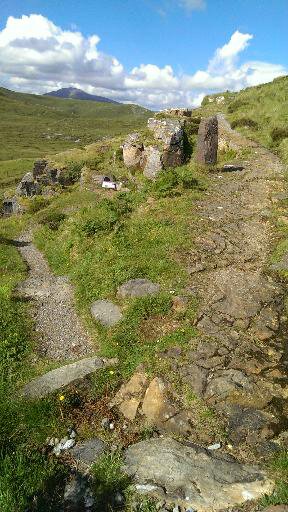
If you step through the eco-gazeebo, on the other side you will find a well made path heading off up the edge of the crag, and a bronze statue of a geologist encouraging you to see where it may lead. Anyone with two functional legs and a moderate amount of fitness can follow from here, but by its very nature the terrain beyond this point is unsuitable for people with mobility difficulties and is absolutely not wheelchair friendly. If you suffer from vertigo you might also want to give this a miss - there are some steep climbs with even steeper drops on one side.

Everybody else, follow me - this is a spectacular journey through time and landscape.
You follow the path along the side of the hill and before long you come across a fork. The right hand fork takes you on the rest of the walk, the left hand takes you down a short dead end where two inscribed slabs give you information about fossilised deep sea worms that can be found here, a few hundred feet above sea level. 
Yet more evidence that the landscape of today is radically different from the landscape of the past.

Make your way back to the main path, and there's another carved stone showing what the worms would have looked like, swishing around in shallow tropical seas so many millennia ago.
 The path leads you through a geological timeline for the rocks in these parts, all the time ever so gently taking you higher and higher. The path at this point is not steep, but the drop to your left does keep getting increasingly pronounced. People with vertigo might want to hang on to a companion, or stare fixedly up the hill at this point - although if heights really are a problem for you be warned - it's only going to get worse from here. Trust me though, the views are unquestionably worth it - they really are spectacular!
As the trail leads you further up the hill you are treated to many features created out of the rock that forms this amazing landscape. If you look up from the timeline section of the trail you'll see a perfectly formed stone sphere constructed in the manner of a dry stone wall. It sits on the side of the hill without explanation. I have no idea what it demonstrates, but it looks extraordinarily cool.
Other - what shall I call them? Exhibits, I guess - are more informative than decorative, although there is a strong and pleasing sense of  design throughout the crag. The two stone hands pictured here illustrate the difference between the sandy coloured rock at the bottom and the grey coloured rock above. Place one hand on each, you are told, and you are spanning three hundred million years of history.

Seriously, where else can you go and hold three hundred million years between your hands? 
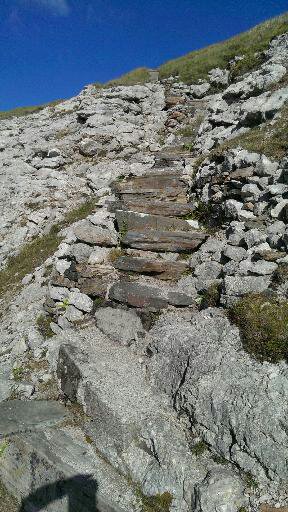
Eventually the path takes you up a steepish set of stone steps. Again, care is required - it's not in any way a difficult climb, but at the same time you need to remember that the consequences of a fall could well involve dropping a few hundred feet to the road below - something which I suspect would be less than fun.
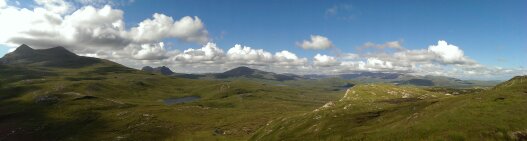
As you climb you'll want to keep your eye on the view though, because the higher you get, the more you can see. Once you reach the top you are rewarded with an utterly spectacular viewpoint offering views across Assynt and Coigach and beyond. Truly spectacular they must be seen to be believed.
I mean, look at it - have you ever seen anything more beautiful? Here you're looking out towards Lochinver with Cul Mor at the far left, the long ridge of Suilven in the distance just to the right of it and Canisp more or less in the middle of the image. Under blue August skies I honestly could have sat there all day watching the shadows of the clouds scoot across the hills and valleys.
From the viewpoint the path takes you along the top of the crag. The views are amazing, but you do become aware that you're at the top of a hill. On the day I was there the wind was blowing pretty fiercely and I was obliged to remove my hat* because if I hadn't it would currently still be flying somewhere in the jetstream.

The path takes you back along the top of the crag until you are more or less above the car park, and then begins to descend. There is one final viewpoint, looking out towards Coigach with the distant hill Stac Polliagh framed once more in the "V" formed by Cul Baeg and Cul Mor.
The flat triangular stone in the foreground of this picture is inscribed with the words of acclaimed Scottish poet Norman MacCaig:
"I don't remember the Eagle going away
but I'll never forget the Eagle shaped space it left
stamped on the air."
   
Reading those words and looking at that view, I could feel the eagle shaped space in the air. Assynt is a wild, wild place and from this vantage point you can really appreciate that without all the hassle of day long walks and cumbersome walking gear.
But it was getting late, so I began the descent back to the car, knowing that the following day we'd be pointing the car towards Coigach and getting deep into that landscape.

*Rather a big thing from my point of view - I am seldom seen without a hat.