Showing posts with label Highlands. Show all posts

Sunday, 24 May 2015

Gathering again in Glencoe.

Here at Snail Towers we have mixed feelings about Glencoe.

It is, as anyone who has hiked, cycled or driven through it (or seen Skyfall) will know, breathtakingly, jaw droppingly, heart breakingly beautiful. It doesn't matter what time of year you go there, there is always something to delight the eye and thrill the senses. It's a magical location - indeed I've gone on about how brilliant it is at some length in the past.

So why the mixed feelings?

Well, Glencoe is a few miles south of the Caravan Club site at Bunree, and Bunree is our usual stop-over spot on the way south after a visit to Strathnaver. On our way north we tend not to hang around, which means that leisurely visits to Glencoe almost always mean we're on our way home and they can sometimes be tinged with a touch of "end of holiday blues".

So it was on this occasion. We were heading hoime from our blissful break at Grummore in the far north, and had paused for two nights at Bunree, figuring a day off from driving might make us less zombified on our return, as well as giving us a chance to spend some time taking in the aforementioned magnificence of Glencoe.

So, our one full day at Bunree began with a lazy start, a full "caravan breakfast" of bacon, eggs, fried bread and coffee, before we set out to take in the beauty of the glen. The cloud was low on this late spring day, and there was more than a hint of drizzle in the air. It didn't matter.

The heads of the hills on either side of the glen were visible, and they towered over us as we made our way from the sea level northern end of the glen, along the A82, climbing up towards the southern exit of the glen on Rannoch Moor.

If you're coming from the north, the first thing you see as you enter the glen is Loch Achtriochtan. As lochs go it's pretty tiny - you'd lose it a thousand times over in Loch Naver or Loch Shin, but as I've been insisting for most of my life, size isn't everything. This roundish sheet of water often acts as a perfect mirror, and it offers any number of perfect photo opportunities on a bright clear day as the hills and the sky are reflected in its surface. It can be heartbreakingly lovely.

This day, however, was not such a day.

The sky was grey. The clouds were low, the sky was grey and the loch was rippled by a steady breeze, so reflections were out of the question. Glencoe, like so many other stunning locations in Scotland is in no way dependent on the weather for its beauty. We drove on, up the glen, the mountains on either side of us brooding beneath leaden skies, the grey asphalt ribbon of the A82 led us up and on to the northern edge of Rannoch Moor.

Where we promptly turned around and headed back down through the glen.

You see, Glencoe is always a spectacle, but it's far more spectacular when approached from the south. Approaching from the heights of Rannoch Moor, suddenly deep grey craggy rocks rise up on either side of you as the road sweeps you around to the right, over a gorge cut by one of the branches of the rive coe with a huge waterfall on your left.

In the heat of the summer this waterfall, which drops the river coe about forty feet into the gorge, is little more than a plucky trickle. But in the spring, when the rain that Scotland is so famous for joins forces with the snow melting on the peaks of the mountains it transforms into an angry, roaring, frothing cascade. It can be truly breathtaking. The road then carries you on, through a gap cut through a towering wall of (I think) granite to form a door like entrance into the glen itself. 

And then, there you are. Coming from the south the road snakes you to the right and along the right hand side of the glen. But now, instead of climbing up a hill, you're starting high and the whole glen (one of the best exposed examples of what my geologist friends refer to as "cauldron subsidence" - I have no idea what that means, but it sure sounds impressive) is laid out before you, and it's astounding.

This view is widely acknowledged to be one of the most spectacular in Scotland, which to our way of thinking makes it one of the most spectacular in the world. There are two main parking areasto the left of the A82 where you can stop and soak it all in, or start any kind of walk from a gentle amble along the valley floor to a more ambitious attempt on the peaks.

Whatever you do though, DON'T stop in either of the main parking spots if you want to sit in your car and gaze at the view in peace, because the chances are you won't get any. It's inevitable that a place of such beauty will attract people who want to enjoy that beauty - we can hardly complain, we're tourists too! However, if you stay with your car you will be permenantly surrounded by scores of people who have been given five minutes to get off their tour coach, get a picture and get back back on the bus. Let's just say they don't add to the air of tranquility and leave it at that.

And then there's the piper. There's almost always a bloody piper.

Now. I love the pipes. I've always loved them. As a kid my Grandma brought me back a "scottish piper" doll from a trip to Edinburgh, and for a very long time I was determined to learn to play the bagpipes like the kilted military men I saw on the White Heather Club at New Years*. Looking bakcm this was a desire my family paid keen lipservice to, but somehow they never managed to find me a set of pipes to play.**

I have to be honest, I can't say I blame them.

But I do love the pipes. Both the traditional styles of the Massed Pipes and Drums and folk hero stalwarts such as Norman MacLean, and the more modern high octane "BagRock" offerings of the likes of the excellent Red Hot Chilli Pipers. There is something ethereal about a well played set of pipes, and you'd imagine that to hear the strains of traditional bagpipes in the heart of Glencoe would be a truly soulful experience.

Sorry. You'd be wrong.

I should be clear. At no point have we ever stopped in Glencoe and been afflicted by the sound of a bad piper. (Which is a mercy, because bad pipe playing is even more offensive to the ear than the wail of a badly played violin.) It's just that there, in the heart of the most spectacular landscape feature Lochaber has to offer***, I want to listen to the wind, to the rain, to the birdsong. Not to another rendition of "Scotland the Brave" or "Highland Cathedral".

It's really intrusive too. You can escape the crowds by getting out of the car and walking for a bit. The drone of the pipes can be heard from one end of the glen to the other if the wind is right.

Anyway.

The grey snake of the A82 drags you northwards around the side of the glen, back past Loch Achtriochtan, out of the glen and on to the village of Glencoe, a couple of miles to the north, nestling on the shores of Loch Leven.

Glencoe isn't a big place, but it's the biggest place within an hour's drive that isn't Fort William and it boasts all the amenities that you might need. There's a garage, a couple of gorcery stores - including a new and rather well appointed Co-op - a couple of hotels, the local Mountain Rescue Station and a fair number of BnBs. And attached to one of the hotels by the side of the A82 is the duck egg blue brilliance of The Glencoe Gathering.

We've eaten here a few times, but I've only written about it once before, on our first visit when the place was pretty new. On that visit we had an unfortunate incident with a garlicky chicken skewer. The fact that on one occasion we were served under-done chicken and yet we still went back tells you how good this place is.

And it really is that good. And I should stress that the bad chicken skewer incident was a true one off that was dealt with at the time and we've never ever had a problem like that since.

We pulled into the gravelled car park and made our way around the side of the wooden building to the front "Muddy Boots" entrance which leads you into the bar area. The rear door, labeled "fancy shoes" takes you into the restairant area - but both parts of the establishment serve the same menu and the view from the bar is better.

We took our seats, ordered drinks, and settled down to admire the view with menus in hand. Mrs Snail immediately went for the garlicky chicken skewers, while I eschewed the regular menu and ordered the Montreal Steak from the specials board. Then we sat back and took in our surroundings.

The bar area is a relaxed and informal space with wooden floors and either white painted or bare brick walls which are decorated with photographs of people climbing in the ice and snow of the winter Nevis Range. There's an acoustic guitar on a guitar stand in one corner bearing many signatures I didn't recognise, and the bar itself in another little niche.

The waitress who served us was clearly new to the job, and monumentally nervous (she eventually confided that it was her first day), but she was charming and, given it was her first day, rather good at it. The softly spoken bearded gentleman behind the bar who was clearly in charge provided her with gentle and relaxed instruction and all was well.

All was ever weller**** when the food arrived.

Those garlic skewers.. ooooooooh
Mrs Snail opted to give the Garlicky Chicken Skewers another try, and they were very, very good indeed. I mean, obviously if you don't like garlic you'd want to steer clear, but everyone else? Oh, you are just going to want to dig in. The garlic isn't overpowering, but it's strong enough that you're getting that hard alium hit. Married up with the onions and peppers with the slightly bitter earthy background from the chargrill the whole thing balances to create perfect harmony in your mouth.

Not the biggest steak in the world, but oh myyyyyyy, the FLAVOUR!!!!!!!!!!!!!!!!!!!!!!
I'd raided the specials board and plumped for the Montreal Steak. Now, I claim to be a foodie, and I love a good steak, but I'd never heard of a Montreal Steak until I visited the Gathering. Wikipedia however tells me that this is, in face, a thing. Whatever, it was a taste explosion on my tongue with the heat of Cayenne, the flavours of garlic and pepper and I know not what else. Even better, beneath the seasoning was the flavour of really good meaty char-grilled beef. It was juicy. It was tender. It was sublime.

Both meals came with fairly chunky chips (and they were listed as chips on the menu - none of your "fries" nonsense here) that were pale gold, crispy on the outside nad fluffy on the inside, and packed full of potato flavour and the speciality of the house - the salt and pepper salad.

This was something that impressed us on our first visit to The Gathering, and it continues to do so. It's one of those things - now I know about it? It seems like the most obvious thing in the world, but I'd never have thought of it in a million years.

Rocket is a famously peppery salad leaf. Samphire is a famously salty coastal vegetable. Salt and pepper is perhaps the most basic of flavour combinations, so Rocket and Samphire salad is a no-brainer - but have you ever seen it before? Because I haven't.

In short, lunch was amazing!

Everyone should visit Glencoe at least once in thier lives. That means you should visit Glencoe, if you haven't already had that privillage. While you're there, you're going to need to eat. You should eat at the Glencoe Gathering. To do anything else would be a wasted opportunity!


*And yes. I am aware that this dates me.

**Although I noticed with some amusement recently that they were selling them in Lidl, of all places. I was sorely tempted, but resisited becasue I like being married...

***No small claim for a district that also boasts Ben Nevis.

****What? It's a word. I just wrote it!

Sunday, 10 May 2015

Our Deer friends, and other animals.

I'm probably going to talk about birds again this week, but not just birds.

You see, one of the many, many things about the northern highlands is the sheer amount of wildlife you can see without making any real effort. A Grummore story I think I've told before on the blog is the time a fellow caravanner we christened "Pink Trousers" because that was all he seemed to wear enquired "Do you ever see Red Deer here?" At the moment he asked the question there were about a dozen of the beasts grazing on the hill behind him.

Like these ladies, looking down on the site from above.

As a kid growing up in the Doncaster of the nineteen seventies and eighties I never really believed I'd ever get to see wild red deer, or birds of prey, or any large wild animal up close. Driving around Sutherland they are, frankly, pretty difficult to avoid. Take these chaps, for example:

Do we have two heads, or are you really bad at photographic composition?
These two were part of a large-ish group of young stags on the road between Syre and Kinbrace. We had to stop the car because several of them were standing inthe middle of the road, while others were perfectly happy just to stand and pose. Like this handsome chap:

You lookin' at me?
Now, I grant you that the road between Syre (which is about half way up Strathnaver, and therefore somewhat off the beaten track) and Kinbrace (which is a tiny rail station in pretty much the middle of nowhere) is not exactly on the high street - you do have to make a bit of an effort to get there. You can get very close to these magnificent creatures without going very far off the main road at all.

Take this guy:

Do you mind? I'm on my lunch break!
 This mature stag (he was massive) was calmly mowing the lawn in one of the gardens in Kylesku the first time we were there. The very nice gentlemen working on the rennovations of the Kylesku Hotel
told us that he was a regular visitor, and that earlier he'd been strutting his stuff up and down the pavement in front of the houses.

Red Deer are the largest wild land animals we have on these islands. An adult stag can weigh the better part of forty stones and stand more than two metres tall. They are very, very impressive creatures to look at and exude a sense of superior disdain that any prey species with no surviving predators might well adopt. Once red deer in the highlands were predated by Lynx and Wolves. These days maybe a hungry fox might have a go at a fawn, but beyond that the only threat they face is humans with rifles - although they are now so numerous in the highlands that there are movements afoot to re-introduce both the Wolf and the Lynx.

Personally, given the dependence of the highland economy on sheep, I think any such reintroduction is unlikely - were I a wolf or a lynx and I had the choice between taking down a sheep or a stag with it's very, very pointy hat, I'd go for the sheep every time, and I really can't see the shepherds being OK with that.

We talked about birds of prey last week, so I won't go into them again. But there is any amount of other birdlife to see in the highlands.

We're the national bird of Finland. Did you know that?
Heading back to Grummore from the east coast we passed a lochan just above Syre and came across this pair of Whooper Swans and their three cygnets.
We'll be the national bird of Finland when we grow up.
They weren't particularly keen on hanging around to say "hello", and cruised off towards the opposite bank as soon as we saw them - in that "we were going over here anyway, it's got nothing to do with you" way that swans have.

Far less shy were the Mute Swans who hang around the Bunree Caravan Club site just south of Fort William. bunree has long been our staging point on the way to the far north, and there's been a family of mute swans there for as long as we've been visiting.

Hello, I'm a mute swan. You will never be this awesome.
Obviously it's easiest to spot the wildlife that just comes to you - like the red deer at Grummore and the mute swans at Bunree. The fact that the wildlife is there though - well that doesn't guarantee it'll actually show itself.

The warden's office at Grummore proudly displays a picture of an Osprey catching a huge trout from the loch just opposite the site - we've never seen ospreys there. The office also displays a picture of a Pine Marten sitting on the bird table that is positioned next to our favourite pitch on the site. We occupoed that pitch for two weeks on our last visit to Strathnacer. We baited the bird table with peanut butter (a pine marten favourite, apparently) every single night. did we see a pine marten?

No. We did not.

That, of course, is the nature of wildlife. It's wild. You can't make it turn up when you want it to.

Which is why we were so thrilled on a trip to Dornoch on the east coast when we pulled into what we think of as the "seal spotting laybay" on the single track road that leads you into Dornoch along the edge of Loch Fleet. There were seals - so-called "Common Seals" or, in my preferred nomenchlature "Harbour Seals", because I refuse to call these glorious amphibious mammals "common".

There's a lot of us, but we're actually very sophisticated.
I've talked about this seal colony before - and they are endlessly entertaining. At low tide you can sit and watch them basking on sandbanks, like decadant Romans lounging on chaise longe.

At high tide you can watch them swimming around, sticking their heads playfully above the water, and generally being happy seals.

I confess, I have a very soft spot for seals. I've spent hours watching them over the years, in the harbour at Lochinver, or the harbour at Stornoway. From a boat off Northumbeerland's Farne Islands to Poole Harbour inDorset.

People make a big thing about swimming with Dolphins, and I acknowledge that  communing with such creatures in their element must be an amazing experience. But frankly, I'd rather swim with seals. They really are engaging creatures with obvious personalities. But on this particular trip it wasn't the seals that impressed us - it was this guy:

You thought that swan was impressive? Well, look at ME!
We pulled into one of the laybys created for wildlife spotting hoping to see seals, and we did - but far more inpressive was this stately heron who was stalking the shoreline looking for food. He strutted and preened, and we watched in fascination.

A lifetime ago, my eight or nine year old self went on a school trip to Doncaster Museum. There I saw a heron that was pickled in a display case. I have no idea why it made such an impact on me, but I remember it to this day.

I never expected to see a real live heron.

The world has changed since I was a kid. These days you can see a heron flap lazily over your head in Doncaster's town centre, and in Harrogate, where I now live. But this heron, on the shores of Loch Fleet was so close I could almost have reached out and touched it.

And THIS is what makes this part of Scotland so special. Wherever you look there are creatures to see that you might never glimpse elsewhere - and if you could see them elsewhere, yu'd never see them so close.

But don't take my word for it. Go and see.

Saturday, 25 April 2015

A Kylesku surprise

Well, this is a bit of a long one. What can I tell you? There's a lot to say!

The Kylesku Hotel is a place we know well. I've talked about it before and it has the happy distinction of being the only eaterie I can think of that gets just that little bit more awesome every time we visit. We've developed a fairly comfortable relationship with the place - after visiting a couple of times a year for the past decade and a half we recognise some of the staff (they don't recognise us - but that's hardly surprising, they see hundreds of different customers a week and besides, we're not that remarkable...) and even have a favourite table.

Well, we had a favourite table.

As indicated at the end of last week's edition, after discovering that Lochinver was mostly closed we headed north in the sure and certain knowledge that there would be no surprises at the The Kylesku Hotel. We were wrong.

As I've mentioned before the hotel sits just off the main road north, next to what used to be the slipway for the Kylesku Ferry before that service was replaced by the elegant arc of concrete which now carries the road across the narrows and onward to the north coast. Turning down what is now the dead end spur that leads to the hotel we were met with a building site. Essentially the whole building looked like it was being rebuilt.

This gave us a moment's pause - after all, it was lunch o'clock and for us that's the most important time of the day. We'd already discovered that all the places we'd been looking forward to eating at in Lochinver were closed - was Kylesku going to let us down too? With some trepidation we made our way quickly (it was chucking it down) along the front of the building to the steps that lead up to the bar praying silently that we weren't going to have to make an empty stomached trip back to Grummore.

We should have known better. The Kylesku Hotel has never let us down - why would it start now?

It was still a surprise though.

The carpet had gone, replaced by sleek hardwood floors. The rustic stripped pine tables which always looked as though they'd been salvaged from a farmhouse kitchen where they'd been loved by generations were gone too, replaced by crisper, paler, slightly more Terrance Conran style furniture, although some of the chairs were still the old green upholstered dark wood. I suspect they'll all be white in due course. The colour scheme lived in my memory as sort of cream and green. Now it's various shades of pebble grey with the odd brightly coloured "accent" wall.

Visually it's one hell of a change, but I rather liked it. It's perhaps a little less cosy, but it's lighter, brighter and very pleasant indeed. Well, take a look:

They also kept the old ship's wheel on the bar...

Oh, and we have a new favourite table:

Look at that view. Just LOOK at it!
The windows are now much bigger, which also goes a long way to making the place seem brighter, and I should be clear that the picture to the left doesn't even begin to do justice to the view down Loch Dubh.

We could have sat there for hours. In fact, we did. Twice, because we went back later in the holiday. To avoid confusion and repetition I'll talk about both visits at once.

On both occasions we were greeted by the very genial Mark, who I think in a previous blog I believe I described as looking as though he "could have stepped straight off Bondai Beach". He still does, and his cheerful friendliness always makes the room light up a little bit.

He brought the menus and explained which of the dishes listed on the specials menu were no longer available. We both elected to start with the potted lamb. I was expecting a sort of cold pate affair, along the lines of the potted beef we're so fond of in Yorkshire, but what we got was this:


It was delicious.
The lamb was served warm, and had clearly been cooked down over a very long time indeed. It was served with griddled bread and, on the first occasion, a celeriac and grain mustard coleslaw. On the second occasion, pictured above (because you're damn right we had it the second time we went too) a celeriac and caper coleslaw.

Personally I preferred the mustardy coleslaw, but since both were excellent, that's by the by.

It was warm, rich, perfectly seasoned and had a flavour so deep there was practically an echo. On a cold, wet, slate grey day it was the perfect comfort food - sort of distilled stew. We loved it so much on our second visit we asked our server if she'd ask the chef for the recipe. She told us with a smile and a twinkle that the chef "never reveals her secrets". I can't say I blame her. If I knew how to make something that perfect I wouldn't tell anybody either.

We'd arrived fairly early on that first visit and had been the first customers. We were in the middle of this unbelievable festival of flavour when the next customer arrived. It didn't occur to me to ask his permission to write about him, so I won't mention the name of this excellent old gentleman, although any regular of the Kylesku Hotel will doubtless know who I'm talking about, because he's something of a fixture.

We'd met him once before, on a previous visit when he'd regaled us with tales of his childhood around Loch Dubh during the war when his father had almost shot one of the top secret midget submarines that trained there after mistaking it for a seal. He sat down to his lunch of Loch Dubh spineys (think small languostines) just as our main courses were arriving, after dispatching Mark to collect a terracotta bust (actually he said "I've got a head in the boot of my car - could you go and get it for me?") which I believe is now displayed in a position of honour in the hotel.

Convivial as he was, when his spineys arrived he directed his full attention to his meal - as is only right. We did too. On that first visit I'd opted for the "Burger of the Day" (yes, I know, no shocks there) and Mrs Snail had gone for an old favourite, the Beetroot and Goat's Cheese Salad.

I won.

On our first visit of the trip the "Burger of the day" was a "Moroccan Lamb Burger" and it was utterly magnificent. I'm wishing I'd taken a picture because it was unutterably beautiful to look at. It was even better to eat. The Lamb patty was juicy, moist and wonderfully seasoned with spices that frankly I didn't recognise but really wanted to get to know better. The chips were, as in the past, about as close to perfect at it is possible for a chip to be - fat, golden and crispy on the outside, white, fluffy and steaming on the inside. There may have been salad. We don't speak of such things here.

Mrs Snail's Beetroot and goat's cheese salad looked amazing - there was more than one colour of beetroot on display which made the plate look exuberant rather than a charnel house - but it was also clear that the cheese did very much belong to the goat, and the goat was less than keen on sharing. There was not a lot of goat's cheese, is what we're saying. Indeed, the shortage was so severe that I didn't get to taste any, which means I only have Mrs Snail's word for the fact that in combination with the beets the effect of the breaded deep fried (we're still in Scotland, food lovers...)* nuggets of goat's cheese was exploseively good.

She wouldn't lie to me though - and if your only criticism of a meal is that you didn't get enough of it, that speaks pretty well of the food...

Our second foray to Kylesku was about a week later. As you already know, we both went for the insanely wonderful potted lamb as our starter, but we like to experiment, so our main choices were different.

Well, alright, I toyed with going for the burger of the day again, but the jovial and omnipresent Mark begged to make a recommendation. "Try the haunch of Venison," he suggested, "they serve it just pink, which is the only way to have it!" Well, you can't move in thois part of the Highlands for red deer, and they look not only magnificent, but also tasty, so how could I resist? Mrs Snail, who lacks my appetite for dead things, opted to try the cheese platter - normally a dessert - as her main. We ordered and settled back to watch the oyster catchers mince their way up and down the slipway, while a pair of herring gulls harrased the prawns that were swimming near the shore.

After a surprisingly short while our server - whose name I never quite got, I think it may have been "Elle" or "Ellie", whatever she was called, she was wonderful - brought our meals out to us. Just take a second and look at this:

I mean, where do I start?!

Haunch of Venison, some kind of braised greens (the menu told me what they were but all I can remember is that they were nice), mashed neeps, straw chips and dots of different vegetable purees, with a potato an haggis dauphinouse.

It really shouldn't have worked. Cheesy potatoes with haggis in them? With Venison? Really?

YES!

I guess many readers have not eaten venison. Let me explain. Imagine the finest beef fillet you have ever eaten.  Times that experience by three. That's bog standard venison. This though. Take your bog standard venison, multiply it by pi, add on your birthday than stick on a few more noughts. It was astounding. The bitterness of the braised greens and the sweetness of the neeps counterpointed each other, and the haggis dauphinouse was, well, interesting.

I know what's in haggis. Essentially, it's all the bits of a sheep you really wouldn't eat, minced up with oatmeal and shoved into a sheeps guts. In spite of that, I rather like it - so long as it's made to be crispy, something that the traditional steaming cannot do, and something that is never going to happen if you put it in a dauphinouse. Essentially, on paper, it's a bloody stupid idea.

And yet it worked.

Brilliantly.

The whole plate just came together to become the best meal I have had in some time. It was thge kind of meal you hated to finish. The kind of meal you wanted to be hungry enough to eat again. The kind of meal that makes you wish you were an Michelin inspector so that you could give the place a couple of stars. That good. I'm just going to go on record and suggest that any chef that can put those elements on a plate and make it work is a flat out genius.

By way of contrast Mrs Snail was somewhat less overwhelmed by her Cheese and Biscuits which seemed a little peremptory - three slabs of cheese with a couple of oatcakes, three grapes and a sort of onion marmalade sort of thing which jst didn't pack the pickly punch that a chutney would have provided. This is not a complaint (yes I know, it sounds a lot like one, but honestly it's just when everything is so good the little things that aren't quite perfect really stand out) as such, and although this was a bit of a low point in the culinary experience, the platter had an unexpected saving grace that made even the low point pretty darn high.

Did I mention that their chef was a genius and their waiting staff are awesome?

Well, I'm going to say it again.

Sitting quietly in the centre of the Cheese and Biscuit platter were three little balls of sesame seeds. Mrs Snail nibbled tentatively and then very quckly ate the whole thing - her expression melting into something approaching delighted content. She passed one of them to me and insisted that I try it.

It was amazing. We've christened these nectareous** nuggets of noshableness "sesame brittle", but in fact they were not quite crunchy and not quite chewey, but somewhere rather fascinatingly in-between. They were also sweet but not too sweet, with that nutty toasted sesame flavour that is almost but not quite bitter. They were so good that when our server came over to see if we wanted anything else, we asked for a bowlful, which she very generously provided. Told you the waiting staff were awesome!

On that second visit we skipped dessert - we were in a bit more of a hurry and settled for the sesame brittle balls. On our first visit the weather was so uninviting we did stick around for a third course. I went for their tablet ice-cream, while Mrs Snail went for a Pear tarte tatin with poppy seed syrup.

People who haven't spent much time in Scotland may be unfamiliar with Tablet. Mrs Snail, who doesn't really have a sweet tooth, once described it as "gritty fudge", but to me it is the finest of confections. It is sort of fudge like, but drier and crumblier. It is also outrageously sweet. My two scoops of vanilla ice-cream were loaded with huge nuggets of the stuff. It was heavenly, but it was Mrs Snails tarte tatin that was the real star.

I confess I was intrigued by the "poppy seed syrup". So far as I was aware the only syrup you're going to get from a poppy seed is opium - which would be an innovative approach to ensuring repeat custom, but I'm guessing it would also attract entirely the wrong clientele. The tarte was just about the right size, just the right texture and actually tasted of pear rather than suger. The syrup was not in fact opium, but a regular suger syrup with poppy seeds in it. They seemed to be a strange addition but they did add an interesting flavour and another layer of texture to the dish. The tarte is supposed to be accompanied with a scoop of Run and Raisin Ice-Cream. I have no idea whether that would have worked, because both Mrs Snail and myself regard Run and Raisin as an abomination so she asked if they would kindly swap it for pouring cream, which worked brilliantly.

And that's the all new Kylesku Hotel. It still gets better every time we visit.

Ultimately I think that the wonderful old regular said it best when he told us "The only thing you can do at the Kylesku is start at the top of the menu and work your way down."

He wasn't wrong.


Postscript:

I loathe prawns in all their forms. Mrs Snail adores them, but now suffers from the kind of allergy to them that makes your lips turn blue and inflates your tongue like a balloon. This is why neither of us ordered what I maintain is the hotel's most spectacular dish - a platoon of langoustines skewered on what is basically a sword which hangs, Damocles like, above a dish of garlic butter. I'm please to report that on our second visit I observed a fellow diner being served with this insanely cool seafood sensation. I'm pleased to see that it's still on the menu and that the presentation has not changed. I'd love to show you a picture of it, but I balked at invading a person's privacy to ask if I could photograph their lunch. If anyone from the hotel is reading this and wants to post a picture in the comments I'd be most grateful...


*Sorry. I do love a good stereotype. And I have visited the chippie in Stonehaven that claims to have invented the deep fried Mars Bar, so it's not like I haven't seen evidence for the idea that the Scots will deep fry anything.

**Sorry again. I wantedto use alliteration so I asked my Facebook friends for a synonym for "delicious" beginning with "N". They have a wide vocabulary, my Facebook friends...

Tuesday, 1 October 2013

The most beautiful beach in the world.

If, as you leave Lochinver on the Ullapool road you take the first left turn after Baddidarrach, you find yourself on a little single track road that hugs the coast for many miles before arcing back inland and joining up with the main road north just south of Kylesku. There are too many delights along this narrow twisting ribbon of asphalt to name in one posting, but I really can't write another word about Assynt without mentioning the wonder that is Achmelvich beach.

We first came here on our first visit to the area twenty years ago, when we walked over from Lochinver on a grey, overcast day. Even in bad weather we were blown away by the astonishing beauty of the place. Anyone who has spent any time at all on the West Coast of Scotland will know that dazzling white sand and crystal clear waters are not unusual in that neck of the woods, but Achmelvich really is something else.

These days we tend to arrive by car, because we are older and lazier than we used to be. The approach by car is pretty interesting, as you leave the narrow and twisty road and join a narrower and twistier road which takes you up a steep hill with a sharp turn at the top. Don't worry though - however tight you might think it looks there's a caravan site by the beach which means the road is towable, which means unless you're driving a very large car indeed you won't have a problem. Indeed, we've often thought of staying at the caravan site, but are unlikely to now for reasons I'll go into later.

There's a largeish carpark behind the beach, equipped with an un-staffed warden's hut displaying information about the area, examples of local flora and fauna and details of the various ranger guided walks and events that happen throughout the year. Beyond that is a short stretch of Maccair (free draining and fertile grassy plain) before you finally hit the beach.

Just look at it!


When the tide is out - as it was in this picture - the beach is huge and insanely inviting. The view is tropical - although the temperature often is not, this is still the highlands after all. To stand on the dazzling white sand, gazing out over the azure waters and breathing in the crisp pure air is to fall in love. You won't be able to help yourself.

You'll see all manner of sea birds here - this bay is where I saw my first family of Eider Ducks, for instance - as well as other, larger wildlife. There is a rather arresting photo in the warden's hut of a Basking Shark crusing just a few metres off shore and whales have been seen off the headland.


Can you not feel the water lapping at your toes?

Sadly, this could in the end be the place's downfall. It looks very peaceful and empty in these pictures. The truth is that beauty this exquisite cannot hide for long and when it is discovered it attracts, well, pretty much everyone.

The brutal truth is that when we first came here nearly two decades ago, this was a deserted stretch of sand. Now, twenty years later the only way we were able to take pictures that were not full of other people was to arrive ridiculously early - and even then this once isolated haven was far from deserted. The caravan site which is just out of shot on the left of these images is now huge and rather chaotic, as are the fields of tents crammed in behind the Machair. 

It is, sadly, an age old problem - and something that particularly afflicts the highlands.

Beautiful places attract people who want to experience that beauty. This is understandable, and more people experiencing beauty is clearly a good thing. But for most places there's a tipping point wher the weight of numbers visiting a place starts to erode that beauty and I think that sadly Achmelvich may be reaching that point.

The question is, what can be done about it? I mean you can let market forces do their work - once the beauty of a place has been destroyed people will stop visiting and the issue resolves itself, but this is hardly satisfactory. But what else do you do?  You can't just restrict access - who do you restrict access to? Who do you say can or cannot visit the beautiful places? I've often joked that while it's fine for us to go to places other tourists should probably stay away - but that really is nothing more than a selfish joke. Such places must be available to everyone.

So. Visit Achmelvich. It really is the most beautiful place in the world. But tread lightly. 

Sunday, 22 September 2013

Eating at the Summer Isles Bar.

I said in the previous post that our interest in the Summer Isles was largely rooted in the shore that overlooks them, and this is unquestionably true.

At the end of that last edition we were just approaching the village of Achiltiebuie - our ultimate destination. Achiltiebuie is much larger now than it was on our first visit back in the mid nineties. There are a lot more houses, a piping school and an excellent village hall which plays host to a regular display of local art and crafts. Sadly it's biggest tourist attraction, the Hydroponicom has been closed for some years and now presents a sorry and semi derelict face to the world.

This is a shame, because the Hydroponicom was awesome. Essentially a massive greenhouse using hydroponic technology to grow all manner of food plants you wouldn't normally expect to find at such northerly latitudes. Amongst the salad crops, fruits and vegetables could be found all manner of exotica - including Bananas! The place also incorporated an exhibition of green technologies and was a genuinely fascinating place to visit. It also provided fresh produce to the Summer Isles Hotel - a vital service in a part of the world where fresh vegetables are still annoyingly hard to come by at times, let alone things like salad leaves that perish quickly.

Well, the Hydroponicom may well be defunct, but the Summer Isles Hotel is still going strong, as is the attached Summer Isles Bar. For us a trip to this area isn't complete until we've eaten here, which means that although there is often a long time between visits we've been coming here regularly for damn near twenty years.

The bar is actually very small, consisting of two rooms that for now I'll call "compact", because calling them "poky" sounds derogatory and I love this place too much to say anything that might sound negative. The bar was originally built in the nineteenth century as a watering hole for local crofters, and has apparently been extended over the last forty years - although if this is the case I can only imagine how snug it must've been back in the day...

You enter through a small porch into the "front room", which boasts patio doors which rather predictably look out onto  a small patio area and the view beyond. These days this room is furnished with dark wood dining tables and chair, and is light and cosy although I rather miss the high backed wooden pew-like arrangements that used to occupy this space to form little booth type areas. Still, there's more room for more people now, and fair's fair - a place as good as this really ought to be able to accommodate as many people as possible.

Beyond this is the bar itself, a small room with an inviting fire and walls covered in pictures of days gone by. There are now windows in this area, all the light coming either from the patio doors in the front section or from lamps. This could make things seem a little gloomy, but actually just gives the place a more intimate feeling.

We actually arrived only just after noon, and both rooms were empty when we entered. We grabbed seats at a table near the patio doors and I wandered into the bar to order drinks and grab a couple of menus. The bar always has an interesting selection of beers brewed in the Highlands, and I think perhaps my only beef with this fantastic little pub is the fact that it sits at the end of a long, narrow and winding road and whenever we visit I'm always driving, which means I can never sample any of them.

I took Mrs Snail's glass of wine and my Coke back to the table and we perused the menu.  The bar is famous rightly for it's seafood, and no review could fail to omit mention of their astonishing seafood platter. For a little bit short of twenty five quid you will be provided with a plate size of a small island piled high with local langoustines, smoked salmon, pickled herring, shellfish and whatever else happens to be in season. It is a sight to behold, let me tell you.

Personally I don't like seafood much, so would never consider such a thing. Mrs Snail loves seafood, and would probably order one every time we came. Sadly, presumably because the culinary gods have a profoundly sick sense of humour she has developed an allergy to shellfish and crustaceans like prawns and langoustines which means the delights of the seafood platter are off limits. One time we were there, she stared so longingly at a neighbouring diner's lunch he actually offered her a langoustine. It really is that good.

But as I say, not for either of us, so Mrs Snail opted for the duo of smoked salmon, and in the absence of my usual burger (the bar is too classy for that) I went for a steak sandwich, which in many ways is the same thing, but in a purer form. There was a little discussion as the waiting staff realised that they didn't have any of the grain mustard mentioned in the menu and wondered whether I'd be happy with English mustard instead.

I assured them I didn't care, and was rewarded with a brown baguette filled with fried steak and onions. There was some side salad nonsense of course, but I'm from Yorkshire, so I ignored it. It was truly lovely. If anything, Mrs Snails smoked salmon duo was even better. Basically her plate was laden with two massive piles of smoked fish, one hot smoked, one cold. Cold smoked salmon leaves me, well, cold. I've never seen much attraction in what is, essentially, raw fish*.

Hot smoked salmon however is one of my very favourite things, however and to my delight the massive piles of piscatorial delight were to big for Mrs Snail to manage so I was able to purloin rather a lot of the hot smoked pile.

It. Was. Astonishing.

Soft and moist on the tongue with that wonderful kick of smoke, it was fish to fall in love with. 

The sky had been looking rather threatening when we arrived (I confess that the picture above was taken as we left) but by the time we'd eaten our lunch the sun was shining so we took the opportunity to adjourn to the patio for coffee. We sat for a while looking out over the stunningly blue sea, out towards the island of Tanera Mor.

As I mentioned in the last post this is the only inhabited island in the Summer Isles, and at the time we were there (August 2013) it was up for sale with an asking price of £2.6 million. I have to say, if I had that kind of money burning a hole in my pocket I'd be making an offer. I've always wanted to live on an island, and an island in such close proximity to such a wonderful eaterie? What could be better?

Of course, from the patio the view is somewhat obscured by the trees that run along the hotel's fence. So, take a look at the panorama you'll see from the beer garden:


Beautiful, isn't it? And the view is always this good. Not always this blue, I'll grant you, but when the weather is poor it just gets more dramatic, not less beautiful.

You really should go.


*Yes, I know, technically it isn't raw because the smoke cures it. But in terms of texture and appearance there is no difference between cold smoked salmon and a slice off a salmon you just dragged out of a stream. Prometheous stole fire from the gods and ended up getting his liver eaten by eagles for all eternity so that we could cook stuff. Given that, it seems rude not to.

Saturday, 21 September 2013

Making our way to the Summer Isles

The Summer Isles are made up of a seemingly endless number of tiny pinpricks of land to the north of Loch Broom, off the coast of Coigach. 

Only one, Tanera Mor, is inhabited and is perhaps best known for issuing its own postage stamps - something it's done since nineteen seventy. Given that according to the 2001 census only five people live on this roadless three and a half kilometre square lump of torrodonian sandstone I've never been entirely sure how they've kept the post office staffed, but fortunately such issues happen above my pay grade so I've never really worried about it. 

We've often gazed across the waters of the Minch and considered paying it a visit, but somehow have never quite managed to actually do it. One day, perhaps...

The truth is our interest in these islands is firmly rooted on the shore that overlooks them - but more of that later.

If you're not approaching by sea, there are only two routes in to the isolated little enclave of villages that occupy the mainland shore beneath the shadow of Ben More Coigach and Stac Pollaigh.You can take the narrow, single track twisty road that runs out of Lochinver, past the Culag woods, the school and Loch Culag, or you can take the narrow, single track, twisty road that branches off the A835 about half way between Ullapool and Elphin, with Cul Baeg and Stac Pollaigh on your right and Ben More Coigaich on your left.

Either way, the scenery is spectacular and the road is easier than you'd imagine. I've said this before, but I've never understood why some people have an issue with single track roads - all you have to do is drive at a sensible speed and pay attention to what's in front of you and what's coming up behind. Things that you should be doing anyway if you're behind the wheel of a car.

So.

The little twisty road winds its way along the northern shore of Loch Gurlainn, on the other side of which stands the lumpen mass of Ben Mor Coigach - all seven hundred and forty three metres of it. Like many big hills in, poor old Ben Mor doesn't look all that impressive. It is, essentially a big rolling rounded lump. As you approach the end of Loch Lurgainn the more diminutive Stac Polliagh (a whole ninety metres shorter) sits demurely on your right, presenting a far more interesting vista.

There's a fairly sizable car park at the base of Stac Pollaigh (it's pronounced "Stak Polly") should you wish to make the ascent. I've never climbed it - but am assured that the summit requires rather a lot of rock scrambling which pretty much guarantees I never will. I'm a hill walker, not a mountaineer, the distinction being that I rather like have solid ground beneath my feet and clinging to a rock face doesn't appeal in any way...

If you feel the same way, eschew the charms of the Stac Polliagh ascent  and bypass the car park you'll leave Loch Lurrigann behind and almost immediately find yourself with the wider but shorter Loch Bad a Ghaill taking its place on your left hand side. To your right you'll catch some views of the sea looking north towards Stoer Point and it's lighthouse, then the road begins to climb and the sea disappears, before reappearing briefly as you descend once more to a "T" Junction. Just before the junction there is a spectacular view out over saltmarsh to a wonderful golden sandy beach and the crystal blue sea of Achnahaird Bay beyond.

It's worth stopping to take a look - especially if the weather is good, because this photograph utterly fails to do it anything approaching justice:

 Honestly. It looks spectacular when you're there.

 Turn right at the junction here and you can gain access to the beach a few hundred yards down the road just turn right when you see the little sign marked "to the beach" - it's a dead giveaway. It's a good beach, provided with more than ample car parking, from which you have access not only to the beach but also to a couple of pleasant footpaths, should you fancy a walk.

Continue on this road and you'll make a loop the two hundred and three metre lump of Mael an Fheadain - the road offering some impressive views to the north, although very few places to stop and enjoy them unless you're walking or cycling. As of 2012 there's a camping and caravan site along here, just outside the little settlement (it really is too small for me to call it a village) of Althandhu. It's a smart and well appointed little place, offering excellent views, great walking and access to the beach. We've never stayed there, but we probably will at some point.

As a point of information I should point out that the Camping and Caravan site marked on my copy of the local OS map by the beach at Achnahaird has been closed for some time, so if you fancy pitching up in this neck of the woods you'll need to keep going for a bit. There are a fair few self catering chalets around Altandhu as well, so there are plenty of opportunities to linger.

Altandhu is also where you'll find what used to be called the "Achiltiebuie Smokehouse", but now seems to have rebranded itself "Summer Isles Foods" - a rebranding which makes sense because while you can see some of the Summer Isles from their car park, you are manifestly not in Achiltiebuie. Here they smoke all manner of local seafood, and operate a little shop which sells not only their own wares, but also high quality stuff from other local producers.

It's a lovely place. You can't take a tour of the production line as such, but since production takes place in what are basically a couple of big sheds, there are huge windows you can peer through, with signboards outside explaining what is going on at each stage. In this pre-packed world, it is very nice indeed to see real food being made. Also, you can stand under the vent from the smoke room and breathe in the awesome smell. Honestly, two or three lungfuls of that are worth the trip ontheir own.

As you leave Altandhu the road begins to climb, and after about a quarter of a mile you have an opportunity to make a hard right turn down to the little harbour at Old Dornie. Nobody lives down there, but there is a very sheltered harbour, protected by the bulk of Isle Ristol - one of the largest of the Summer Isles, and on a sunny day it's a wonderful place to stop for a picnic.

Carry straight on and the road sweeps you on to Polbain - which is basically a street with houses strung along it like gems on a necklace - a tiny settlement posessed of one of the finest village stores we have ever seen. I have no idea how they fit everything in, but there is very little you might need that they don't have.

Beyond Polbain the road sweeps back down to sea level, and then back up towards Achiltiebuie, another sort of "necklace village" which has grown rather a lot since we first ventured down here in the nineties. Achiltiebuie is home to the object of our visit to the Summer Isles, and that my friends is the subject of the next post.


Sunday, 8 September 2013

A walk around Knockan Crag - the heart of the North West Highland Geopark!

I mentioned in an earlier post that geology is important in Assynt, and I've already made an oblique reference to The Rock Route, a driving trail that takes the curious motorist around this unique geological landscape. There are laybys at geologically interesting points, equipped with informative signboards which explain clearly what you're looking at, and why it's important. Indeed, Assynt is part of the North West Highlands Geopark, the centerpiece of which is the excellent visitor centre at Knockan Crag.

This is perhaps my favourite visitor's centre anywhere, mostly because it is so well done, and so utterly appropriate. You see, one of the reasons we love this part of the world is the opportunity it provides for solitude and for getting away from the routine imposed by clocks, timetables and opening times. Well, the Crag is a visitor centre which you can have totally to yourself if you turn up at a quiet time because it has absolutely no staff. As a by product of this it's open twenty four hours a day, fifty two weeks of the year. Turn up and experience it whenever you want - although as you'll see, it might not be a good idea to turn up in the pitch black or in really bad weather...

Knockan Crag is about a mile south of the little Certificated Location we were pitched up on in Elphin, so after a day of vehicular exploration around the wider area I took myself for a little stroll around this geological showcase.

Even from the car park the view is spectacular, looking out across the water, between Cul Mor and Cul Baeg, towards the rocky peak of Stac Pollaidh in the distance.

Looking up the hill from there you can see the little turf roofed shelter that houses the main exhibition. This part of the trail is wheelchair accessible, and fine for people with other mobility issues, I'm afraid that the rest of the crag probably is not...

This is in fact a fairly new exhibition, the centre was refurbished and renovated a few years ago (and indeed in the great Highland spirit of recycling some of the large sign boards from the old display can be seen serving as the walls of a sheep shed in Elphin) and the whole thing is now very slick and interactive.

You're met initially at the entrance to the little eco shelter by bronze statues of legendary geologists Ben Peach (seated) and John Horne (standing). If you're unfamiliar with these names and have never heard of their achievements in geological theory, don't worry - this is also where the interaction starts.

By the side of Ben Peach's seat (which is large enough for you to share with him and offers a pretty cool photo opportunity) is a set of buttons marked with national flags. Push the flag most closely associated with your language and Messers Peach and Horne will tell you a little bit about themselves, in whatever language you prefer.

Basically- and real geologists will need to forgive me here because I'm going to massively over simplify this - Peach and Horne figured something out that revolutionised our understanding of geology and the way the Earth's crust as we know it today was formed. Before the work they carried out in Assynt the standard view was the fairly logical assumption was that new rocks were laid down on top of old rocks. This "layer cake" idea makes perfect sense and allowed geologists to date the rocks they were looking at.

So far, so straight forward.

The trouble was that here in Assynt some of the oldest rocks in the world are sitting on top of rocks that are much younger and to the nineteenth and early twentieth century geologists this simply didn't make any sense at all. Peach and Horne worked out the solution, and changed the outlook of the science of geology forever. 

In 1907 they identified the "Moine Thrust", a geological feature that runs all the way from Loch Eribol on the North Coast of Scotland, through Assynt and down to Sleat on the Isle of Skye. They showed that the thrust forced one older sheet of rock over the top of a much younger series, masking the geology beneath. Small "windows" in the top plate allow geologists to estimate what the previous geology was like. Assynt is one such window, and through it you can see a great chasm of time.
 
 Inside the little turf roofed gazebo there are many displays and interactive thingamiebobs to help explain what all the different rocks are hereabouts, how they formed, what they're called, where you'll find them and how old they are.

There's also a rather wonderful display around the edge showing the horizon in opaque perspex. Each of the visible hills is not only identified, but the meaning of each of the hill's names is explained. Even better, given that most of the names of landscape features in Assynt have their origins in Gaelic, which has a very different spelling system, you can push a button and have a voice pronounce each of the names correctly.

Turns out I've been mis-pronouncing some of them for years, although I feel safe in the knowledge that I'm not alone in this...

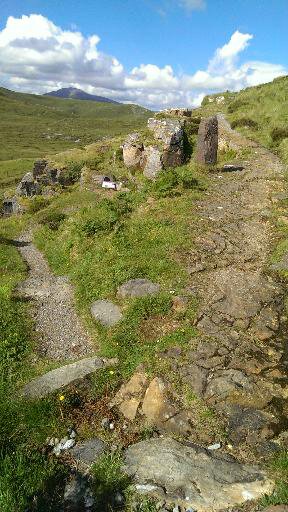
If you step through the eco-gazeebo, on the other side you will find a well made path heading off up the edge of the crag, and a bronze statue of a geologist encouraging you to see where it may lead. Anyone with two functional legs and a moderate amount of fitness can follow from here, but by its very nature the terrain beyond this point is unsuitable for people with mobility difficulties and is absolutely not wheelchair friendly. If you suffer from vertigo you might also want to give this a miss - there are some steep climbs with even steeper drops on one side.

Everybody else, follow me - this is a spectacular journey through time and landscape.
You follow the path along the side of the hill and before long you come across a fork. The right hand fork takes you on the rest of the walk, the left hand takes you down a short dead end where two inscribed slabs give you information about fossilised deep sea worms that can be found here, a few hundred feet above sea level. 
Yet more evidence that the landscape of today is radically different from the landscape of the past.

Make your way back to the main path, and there's another carved stone showing what the worms would have looked like, swishing around in shallow tropical seas so many millennia ago.
 The path leads you through a geological timeline for the rocks in these parts, all the time ever so gently taking you higher and higher. The path at this point is not steep, but the drop to your left does keep getting increasingly pronounced. People with vertigo might want to hang on to a companion, or stare fixedly up the hill at this point - although if heights really are a problem for you be warned - it's only going to get worse from here. Trust me though, the views are unquestionably worth it - they really are spectacular!
As the trail leads you further up the hill you are treated to many features created out of the rock that forms this amazing landscape. If you look up from the timeline section of the trail you'll see a perfectly formed stone sphere constructed in the manner of a dry stone wall. It sits on the side of the hill without explanation. I have no idea what it demonstrates, but it looks extraordinarily cool.
Other - what shall I call them? Exhibits, I guess - are more informative than decorative, although there is a strong and pleasing sense of  design throughout the crag. The two stone hands pictured here illustrate the difference between the sandy coloured rock at the bottom and the grey coloured rock above. Place one hand on each, you are told, and you are spanning three hundred million years of history.

Seriously, where else can you go and hold three hundred million years between your hands? 
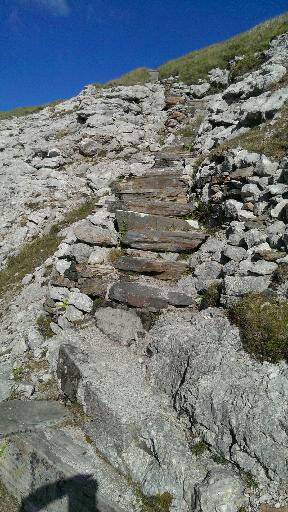
Eventually the path takes you up a steepish set of stone steps. Again, care is required - it's not in any way a difficult climb, but at the same time you need to remember that the consequences of a fall could well involve dropping a few hundred feet to the road below - something which I suspect would be less than fun.
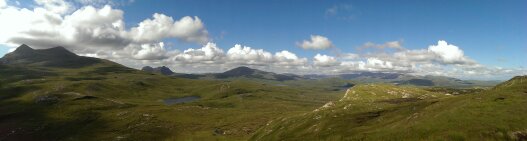
As you climb you'll want to keep your eye on the view though, because the higher you get, the more you can see. Once you reach the top you are rewarded with an utterly spectacular viewpoint offering views across Assynt and Coigach and beyond. Truly spectacular they must be seen to be believed.
I mean, look at it - have you ever seen anything more beautiful? Here you're looking out towards Lochinver with Cul Mor at the far left, the long ridge of Suilven in the distance just to the right of it and Canisp more or less in the middle of the image. Under blue August skies I honestly could have sat there all day watching the shadows of the clouds scoot across the hills and valleys.
From the viewpoint the path takes you along the top of the crag. The views are amazing, but you do become aware that you're at the top of a hill. On the day I was there the wind was blowing pretty fiercely and I was obliged to remove my hat* because if I hadn't it would currently still be flying somewhere in the jetstream.

The path takes you back along the top of the crag until you are more or less above the car park, and then begins to descend. There is one final viewpoint, looking out towards Coigach with the distant hill Stac Polliagh framed once more in the "V" formed by Cul Baeg and Cul Mor.
The flat triangular stone in the foreground of this picture is inscribed with the words of acclaimed Scottish poet Norman MacCaig:
"I don't remember the Eagle going away
but I'll never forget the Eagle shaped space it left
stamped on the air."
   
Reading those words and looking at that view, I could feel the eagle shaped space in the air. Assynt is a wild, wild place and from this vantage point you can really appreciate that without all the hassle of day long walks and cumbersome walking gear.
But it was getting late, so I began the descent back to the car, knowing that the following day we'd be pointing the car towards Coigach and getting deep into that landscape.

*Rather a big thing from my point of view - I am seldom seen without a hat.